
If you are a marketing leader in 2026, the question is no longer if you are using AI, but how you are directing it.
We have officially moved past the “101 Curiosity” phase. Today, prompt engineering isn’t just a trendy skill—it’s a required core competency listed in over 40% of Senior Marketing Manager job descriptions. Startups and scaling businesses are actively trying to replace expensive, slow-moving agency retainers with a $20-a-month LLM subscription and a robust prompt library.
But there’s a catch. Most marketing teams are slamming headfirst into the “Quality-Scale Paradox.” They are generating more content than ever, but the strategic depth is missing. They are writing basic prompts and getting basic, sanitized corporate fluff in return.
To win in today’s landscape, you have to pivot from simply writing prompts to engineering marketing systems. You need prompt orchestration.
The Crisis of “AI Fluff” and the 50% Editing Tax
Why do so many AI-generated marketing campaigns feel hollow? Because of what we call the Editing Tax.
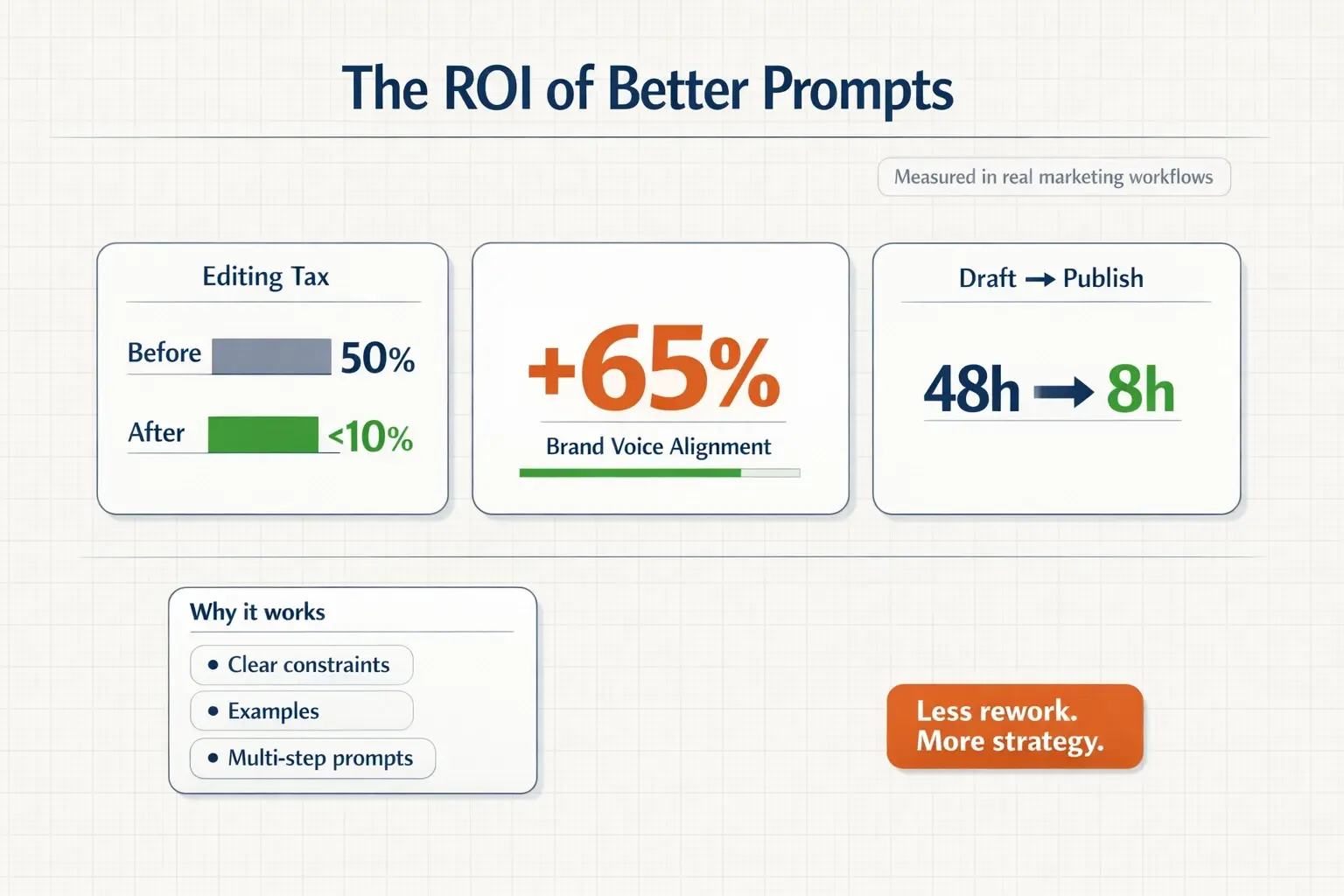
Right now, marketers using generic prompting frameworks report spending up to 50% of their time “polishing” raw AI drafts. They ask an LLM to write a blog post, realize it sounds like a robot reading a textbook, and then spend hours rewriting it to match their brand voice. You aren’t saving time at that point; you are just shifting the bottleneck.
For startups looking to scale, particularly those focused on growth hacking ecommerce, efficiency is everything. You cannot afford to trade an agency for a tool that requires massive manual oversight. By applying advanced prompt engineering techniques, you can reduce this Editing Tax to under 10%.
The Anatomy of an Elite Marketing Prompt
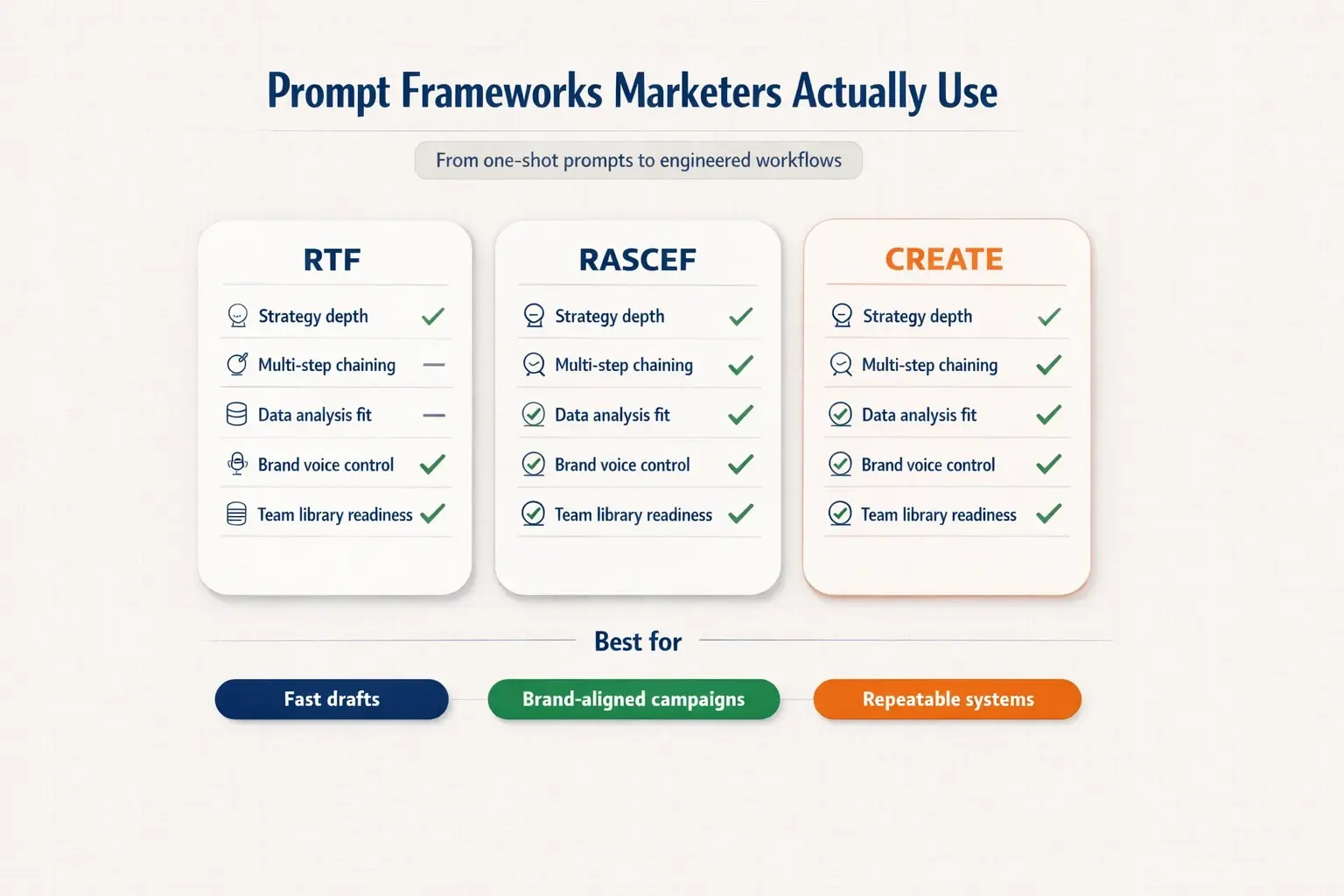
If you’ve taken a baseline AI course, you’ve probably been taught the basic RTF framework: Role, Task, Format. (“Act as a marketer, write a blog post, format it as an HTML article.”)
This works for simple copywriting, but it fails completely for complex B2B workflows or nuanced strategic planning. Elite marketers use the RASCEF framework. Moving to this structured framework increases blind “Brand Voice Alignment” scores by a staggering 65% compared to one-shot prompts.
Here is how RASCEF breaks down:
- Role: Who is the AI acting as? (e.g., “A seasoned B2B SaaS product marketer”)
- Action: What is the specific goal? (e.g., “Develop an intent-driven email sequence”)
- Steps: What is the logical progression? (e.g., “First, analyze the pain points. Second, map those to our features. Third, draft the sequence.”)
- Context: Why are we doing this? (e.g., “We are targeting mid-market CFOs who are currently using legacy accounting software.”)
- Examples: What does good look like? (Provide a snippet of your best-performing past campaign.)
- Format: How should it be delivered? (e.g., “A markdown table comparing the three emails.”)
The “Chain-of-Thought” Strategy Workshop
The biggest mistake marketers make is expecting the AI to do all the heavy lifting in a single go. We call this the “one-shot” trap. Advanced prompt engineering relies on Chain-of-Thought (CoT) prompting—breaking a complex strategy down into a sequence of chained prompts.
Use Case 1: Competitive Gap Analysis
Don’t just ask the AI to “analyze competitors.” Orchestrate the system.
- Prompt 1 (Data Ingestion): Feed the AI your competitor’s landing page copy and ask it to extract their primary value propositions.
- Prompt 2 (Audience Mapping): Ask the AI to identify which buyer personas those value propositions appeal to the most.
- Prompt 3 (Gap Identification): Prompt the model to compare those personas against your own feature set to find the “white space” your competitor is missing.
Use Case 2: The ICP Blueprint
Creating an Ideal Customer Profile shouldn’t just be an exercise in guessing demographics. You can chain prompts to analyze customer reviews, synthesize common pain points, and output a detailed psychological profile of your ideal buyer.
The Tool Orchestration Layer: Bridging Data and Creative
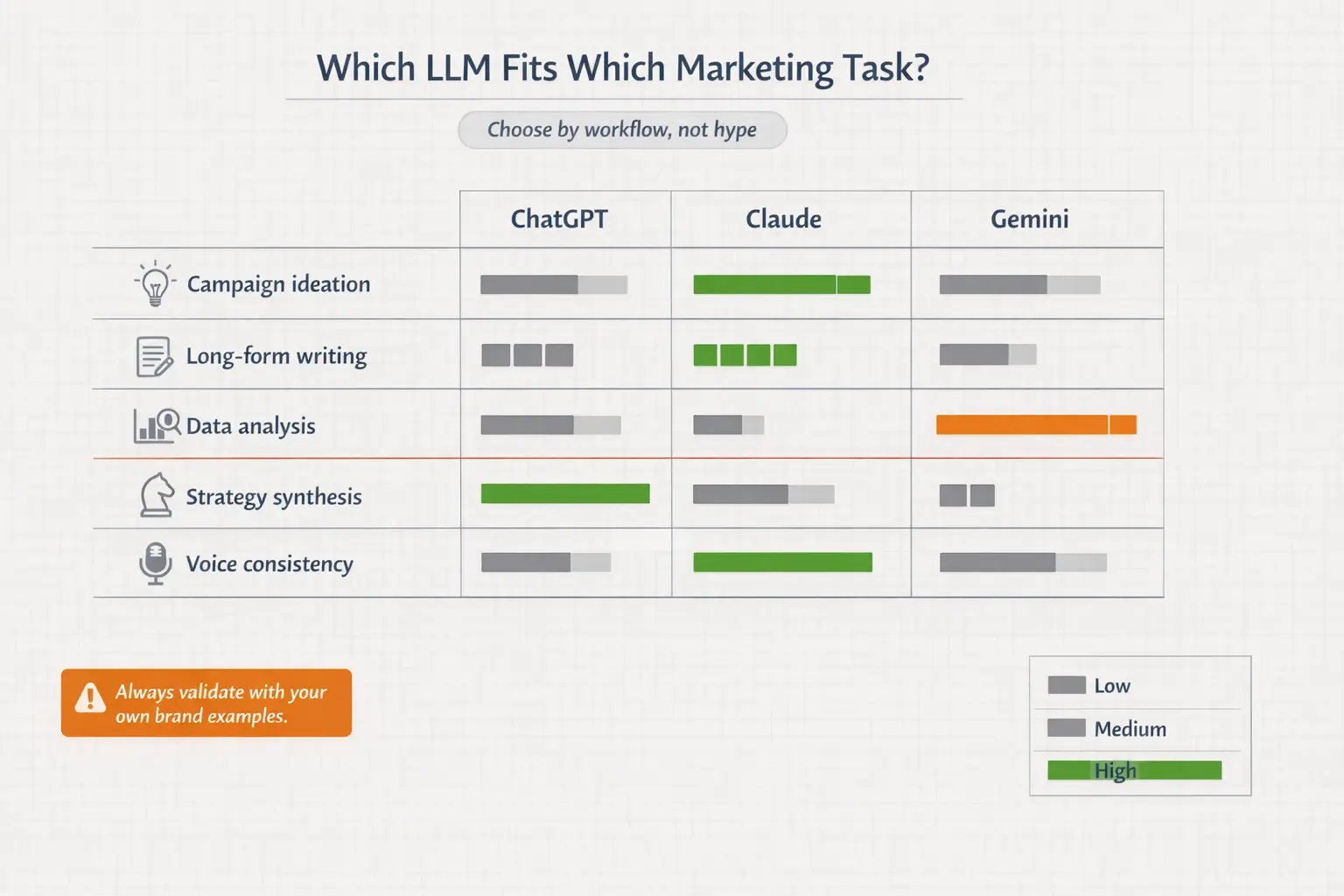
Part of your evaluation process right now is likely figuring out which LLM actually deserves your team’s time. Should you use ChatGPT-4, Claude, or Gemini?
The answer is that elite prompt engineering requires tool orchestration. Different models excel at different marketing tasks. For instance, connecting raw Semrush search volume data or GA4 exports to ChatGPT’s Advanced Data Analysis feature allows you to identify long-tail keyword opportunities. From there, you might move the strategic outline over to Claude, which currently handles conversational brand tone with a bit more nuance.
Technical “Under the Hood” Optimization
This is where 95% of marketing resources stop, but it’s exactly where you need to start paying attention if you want to eliminate generic outputs. To truly master prompt engineering, you need to understand the technical settings of the models you are using.
Manipulating Temperature and Top-P
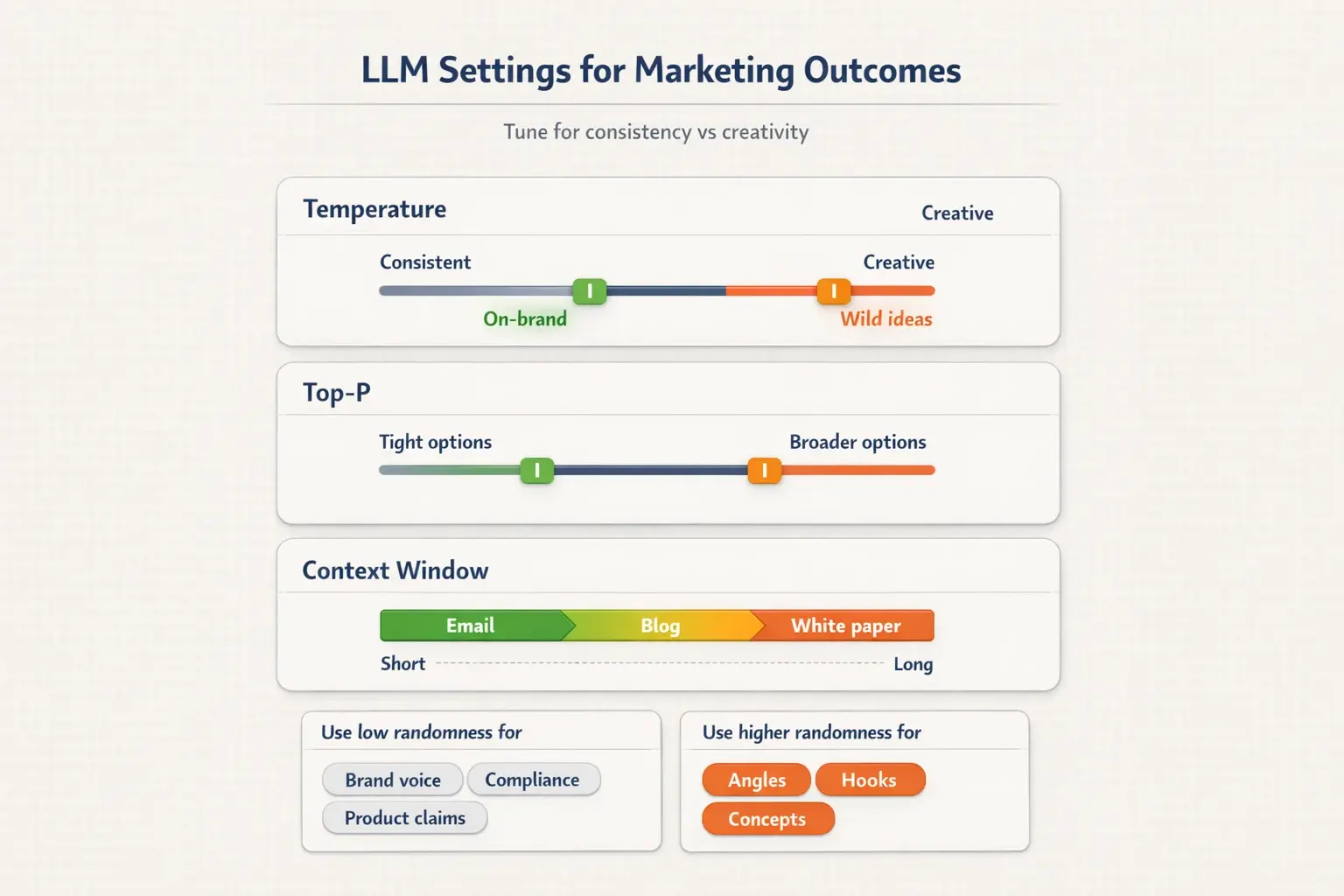
Think of “Temperature” as the AI’s creativity dial, typically set between 0.0 and 1.0.
- Low Temperature (0.1 – 0.3): Highly focused, predictable, and deterministic. Use this when you are prompting the AI to analyze raw marketing data, summarize a dense SEO report, or format a structured list.
- High Temperature (0.7 – 0.9): Creative, varied, and slightly unpredictable. Use this for campaign ideation, ad copy variations, and brainstorming hooks.
Managing Context Windows
A “context window” is simply the model’s memory capacity for a single conversation. If you are feeding an LLM a 50-page whitepaper to repurpose into social media posts, you might push the model past its context window. When this happens, the AI starts “forgetting” the instructions you gave it at the beginning. To prevent this, chunk your inputs. Give the model one chapter at a time, keeping your instructions fresh and ensuring the output remains tightly aligned with your strategy.
The “Brand-DNA” Injection
You shouldn’t have to explain your company’s tone of voice every time you open a new chat window. The most successful marketing teams in 2026 build what we call a “Brand-DNA Injection.”
This leverages basic Retrieval-Augmented Generation (RAG) principles in a way marketers can easily use. Create a master document that contains your brand guidelines, your exact ICP, examples of your highest-converting emails, and a list of words your brand never uses. Make it standard operating procedure that every single prompt chain begins by feeding this document into the model first. This creates an instant guardrail that drastically reduces your editing tax.
Frequently Asked Questions (FAQ)
Can a strong prompt library fully replace my marketing agency?
While a robust prompt library significantly lowers overhead and allows you to execute daily tasks (like drafting copy or basic data analysis) internally, it doesn’t replace the need for strategic human oversight. It shifts your role from content creator to system orchestrator. You are replacing the execution layer, not the strategic layer.
How do I stop AI from sounding so painfully generic?
The AI sounds generic because you aren’t constraining it. You must use the RASCEF framework to provide extreme context and examples. Additionally, try lowering the model’s Temperature setting slightly to rein in its tendency to use flowery, overly enthusiastic adjectives.
Should I be using multi-modal prompts?
Yes. Prompt engineering is no longer just about text. You should be using visual prompting—feeding the AI screenshots of high-performing competitor ads or landing pages and asking it to reverse-engineer the visual hierarchy and psychological triggers used in the design.
Your Next Steps Toward AI Mastery
Choosing to rely on basic prompts is a sure way to let your competitors out-scale and out-maneuver you. The evaluation phase is over—it is time to implement a systemic approach to AI.
At Swipe Directory, we believe in democratizing access to the tools that actually drive business growth. That means moving beyond the basic advice and giving you the unbiased, high-quality frameworks you need to succeed.
Stop settling for the 50% Editing Tax. Start treating your AI models like the high-level strategists they can be when given the right direction. Explore our curated marketing resources, build your internal swipe file, and start chaining your prompts today.