
If you are evaluating marketing automation platforms in 2026, you’ve likely realized that simply dropping another AI tool into your tech stack won’t fix your operational bottlenecks. In fact, disjointed tools often make those bottlenecks worse.
We are officially past the era of basic automation and simple AI writers. Top-tier agencies and scaling startups are transitioning to Autonomous Marketing Orchestration—a systematic approach where AI doesn’t just draft content, but actively manages workflows, routes data, and optimizes campaigns across channels with minimal human intervention.
The real challenge you’re facing isn’t finding a tool that writes good copy. The challenge is the “messy middle” of integration: connecting your CRM, email platform, and conversational bots into a unified, self-sustaining system. As the central hub for marketing productivity, we’ve analyzed the 2026 search landscape and platform capabilities to bring you the definitive integration blueprint.
Moving Beyond Basic Automation: The “Active Intelligence” Shift
According to a recent Harvard Business Review study, deeply integrated AI-driven marketing workflows can boost lead generation by 50% while simultaneously reducing customer acquisition costs (CAC) by over 30%. Furthermore, the Litmus 2026 State of AI in Email Marketing Report reveals that marketers using advanced AI orchestration have seen end-to-end email production times drop from two weeks to less than 24 hours.
With 70% of marketers expecting half of their total operations to be fully AI-driven by the end of 2026, the question is no longer if you should integrate AI, but how you architect it safely and efficiently.
You need a decision framework to determine exactly how these tools connect to your core operations.
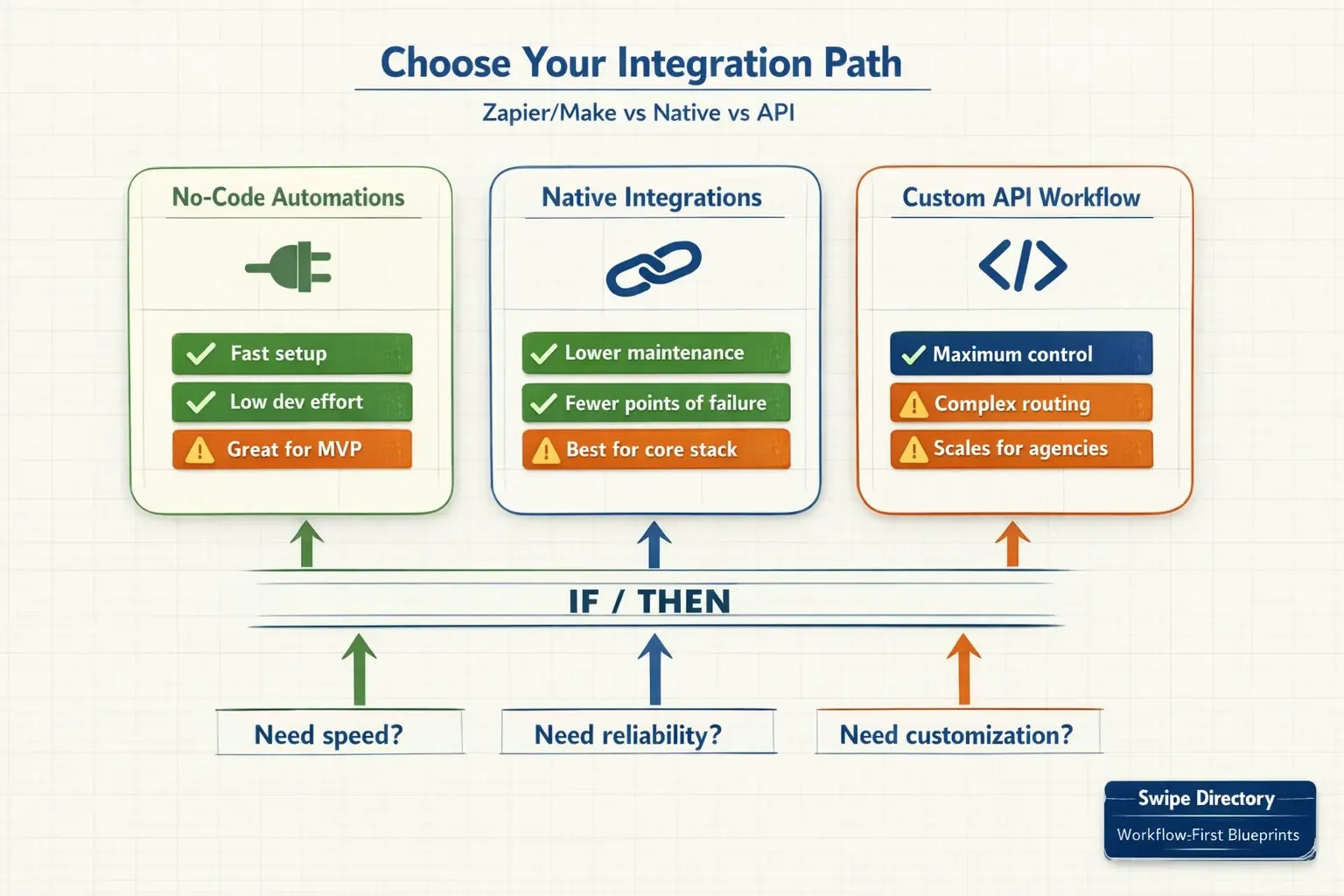 Use this framework to pick the right integration method—speed (no-code), reliability (native), or control (API)—before you invest in tools or implementation.
The Marketing AI Integration Matrix: Evaluating Your Platform Options
When you search for marketing AI solutions today, you’re hit with the “Listicle 2.0” problem—massive lists of 30+ tools that tell you what to buy, but completely ignore how to manage them at scale.
If you are an agency managing multiple client accounts, or a rapidly scaling SMB, your evaluation criteria must focus on multi-client management, governance, and API flexibility. Here is how the top platforms actually stack up in 2026:
- HubSpot: Dominates in volume-driven inspiration. They offer excellent visual examples and free templates. The Vulnerability: It can feel generic out-of-the-box and often requires heavy custom API work to solve deep, agency-specific workflow bottlenecks.
- ActiveCampaign: The pioneer in tech-forward positioning. They heavily focus on “AI Agents” and “Autonomous Marketing” that predicts user behavior before it happens. The Vulnerability: A steep learning curve and a pricing model that can become prohibitive for smaller agencies trying to scale up.
- Campaign Monitor: The champion of agency-centricity. They offer the best infrastructure for white-labeling and multi-client access without creating a login nightmare. The Vulnerability: They are historically slower to integrate bleeding-edge AI features natively compared to their agile competitors.
- Litmus: Leads in strategic thought leadership, particularly around AI governance and distinguishing between reactive and limited-memory AI models. The Vulnerability: The platform leans heavily technical, which can overwhelm teams looking for immediate, out-of-the-box quick wins.
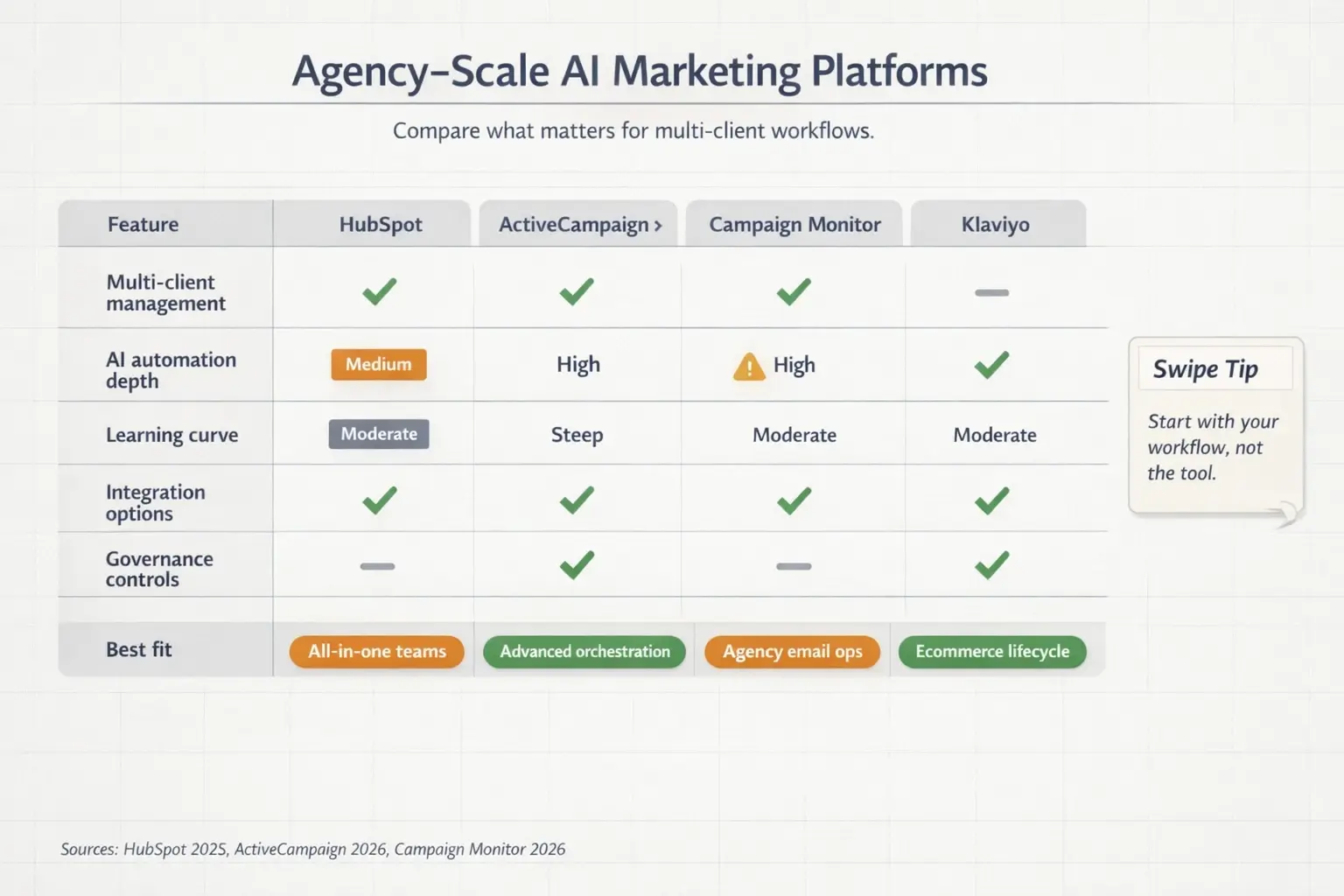 A MOFU-ready matrix that surfaces the real agency constraints—multi-client access, integrations, and governance—so you can shortlist platforms in minutes.
Workflow Blueprints: How to Connect Your AI Stack
Knowing the tools is only 10% of the battle. The other 90% is bridging the “How-To-Integrate” void. Connecting your tools via Zapier, Make, native integrations, or custom APIs requires a specific blueprint.
To create an autonomous marketing workflow, you need to establish a system that utilizes AI-Enhanced Personalization Frameworks. This means moving past basic “Hi [First Name]” merge tags and using AI to write introductions based on scraped LinkedIn data, recent company news, or prior CRM engagement.
Consider how this applies across different verticals:
- In E-commerce: You can orchestrate workflows where a predictive AI model analyzes browsing behavior, triggers a personalized chatbot sequence, and dynamically generates an email offering a unique bundle. These growth hacking ecommerce workflows rely on native API integrations for split-second timing.
- In B2B SaaS: Implementing advanced growth hacking techniques requires orchestrating limited-memory AI. For instance, connecting your lead scoring system to an AI agent that automatically drafts hyper-personalized nurture sequences based on the prospect’s last three interactions with your documentation.
- In Medical & Therapy: Compliance is everything. When healthcare growth hacking agencies build workflows, they use webhook-based integrations that strip Personally Identifiable Information (PII) before running queries through large language models, ensuring strict HIPAA compliance while still automating appointment reminders.
Calculating the ROI of AI Marketing Efficiency
One of the biggest hurdles in getting stakeholder buy-in for AI integration is the lack of concrete ROI frameworks. You cannot just promise “more leads.” You must build an AI ROI Calculator based on operational efficiency gains.
The Formula for AI Operational ROI:(Hours Saved per Campaign × Average Hourly Rate of Creators) + (Incremental Revenue from AI Lead Lift) – (Cost of AI Platform + Integration Maintenance) = True ROI
By mapping this out, you shift the conversation from the cost of software to the exponential value of time and automated revenue generation.
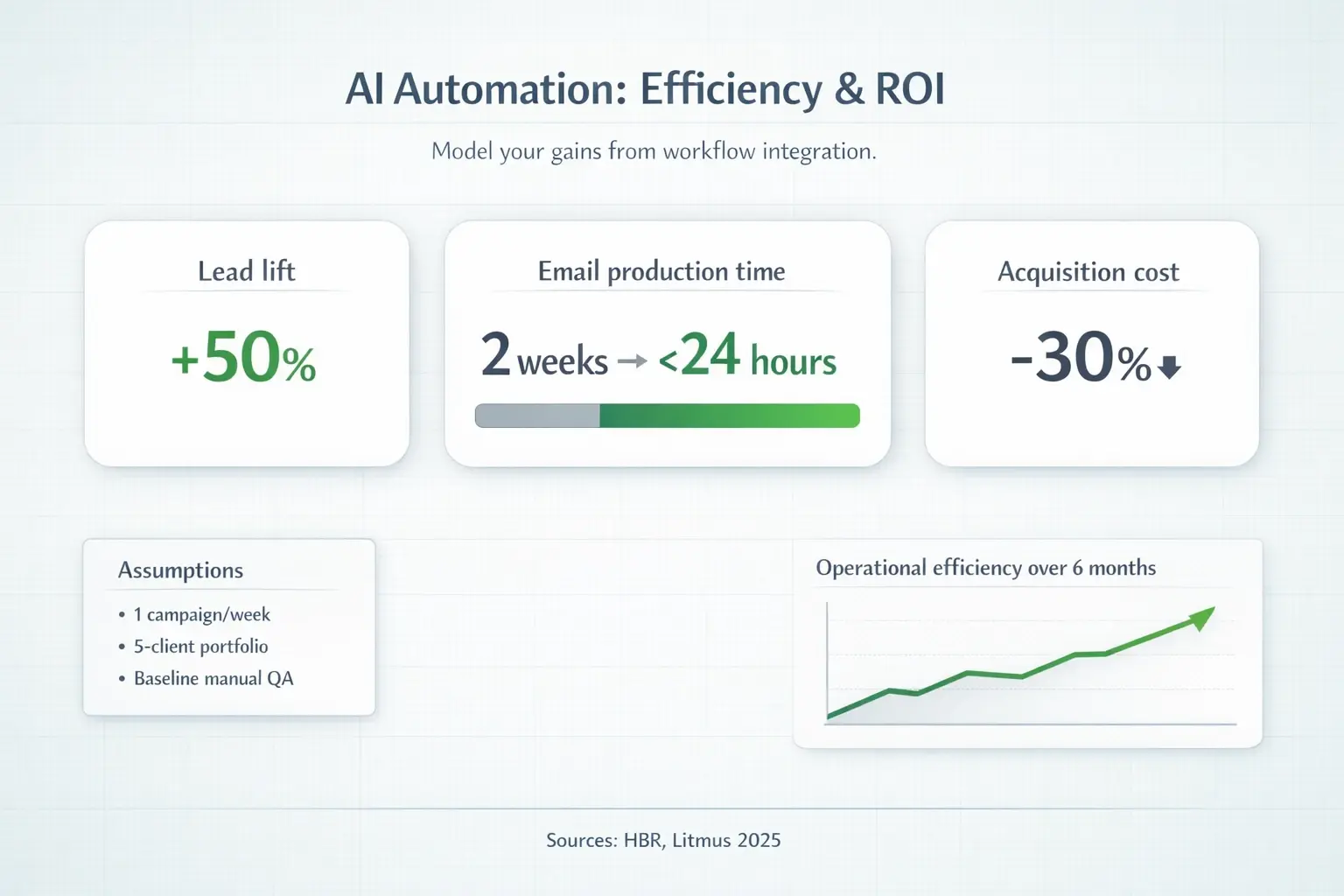 Quantify automation outcomes with defensible assumptions—pair time-to-produce savings with lead lift and CAC reduction to justify integration work.
AI Governance and Ethics: Mitigating Risk in Your Agency
As your workflows become more autonomous, your risk profile changes. Google’s 2026 search quality rater guidelines now heavily penalize unchecked, low-quality AI content, making governance a top priority.
The hidden concern for decision-makers evaluating platforms right now is: “How do I integrate AI without my chatbot hallucinating or violating GDPR?”
The solution is implementing an AI Humanizer Lens alongside strict governance protocols. Automation should handle data routing, predictive sending, and initial drafting, but the architecture must include mandatory “Human-in-the-loop” (HITL) approval gates. You need platforms that offer audit logs for AI-generated outputs, allowing you to trace back exactly which prompt generated a specific piece of live copy.
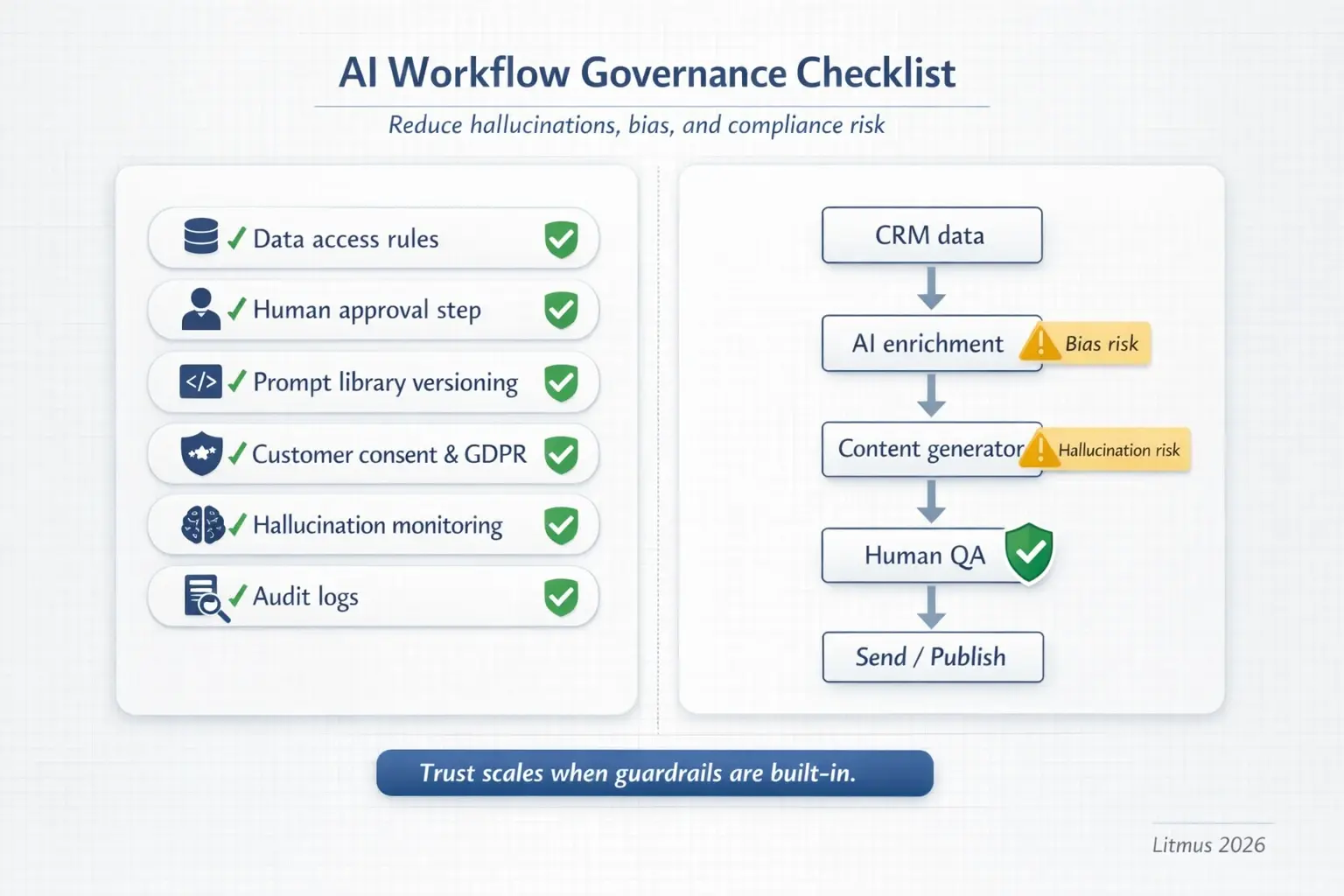 A practical governance layer prevents expensive failures—add human approval, audit logs, and monitoring so automation improves performance without risking compliance.
Frequently Asked Questions (FAQ)
How do I handle 10+ clients without a login nightmare?
If scalability is your primary constraint, prioritize platforms designed for agency infrastructure over those with the flashiest AI. Solutions like Campaign Monitor offer parent-child account structures. You can then map your AI orchestration layer (via Make or Zapier) globally across client sub-accounts, maintaining one central hub for your team while keeping client data siloed.
I need an AI-generated email that doesn’t look like a bot wrote it. How do I achieve this?
Stop relying on out-of-the-box prompts. Implement an AI-Enhanced Personalization Framework where your prompts are fed dynamic variables from your CRM. Instead of “Write a sales email,” your automation should trigger a prompt like: “Analyze {ProspectLinkedInSummary} and {RecentCompanyNews_Trigger}, then draft a 50-word introduction tying their recent product launch to our efficiency software. Tone: professional, concise, zero fluff.”
What is the difference between Reactive AI and Limited Memory AI in email marketing?
Reactive AI responds to an immediate trigger (e.g., a user abandons a cart, and the AI generates a standard reminder email). Limited Memory AI, which top platforms are standardizing in 2026, analyzes historical user data (past opens, browsing behavior over 6 months, seasonal buying habits) to predictively generate and send content at the exact moment the user is most likely to convert.
Next Steps for Your AI Integration Journey
Transitioning to Autonomous Marketing Orchestration requires moving confidently from evaluation to execution. Don’t waste time trying to reinvent the wheel or piecing together fragmented tutorials.
To streamline your technology evaluation and access the exact integration blueprints that high-performing agencies are using this year, dive into our curated swipe resources. There, you’ll find unbiased platform rankings, tested AI prompt templates, and the specific automation recipes you need to turn your tech stack into a seamless, revenue-generating machine.