
Imagine this: You’re the marketing director for a disruptive, witty software startup. Your brand voice is playful, a little sarcastic, and deeply relatable. You decide to launch in Germany, so you feed your most successful ad copy into a standard AI translation tool.
When the campaign goes live, engagement plummets. Why? Because the AI didn’t translate your playful sarcasm—it translated your literal words. To your new German audience, your brand didn’t sound witty; it sounded bureaucratic, aggressive, and completely out of touch.
This scenario is playing out across the globe in 2026. As businesses race to scale internationally, they are discovering a crucial lesson: translation is about words, but localization is about culture. As we navigate the complexities of global expansion today, mastering AI-driven content localization—specifically the advanced challenge of preserving your brand’s unique tone across cultural divides—has become a non-negotiable skill.
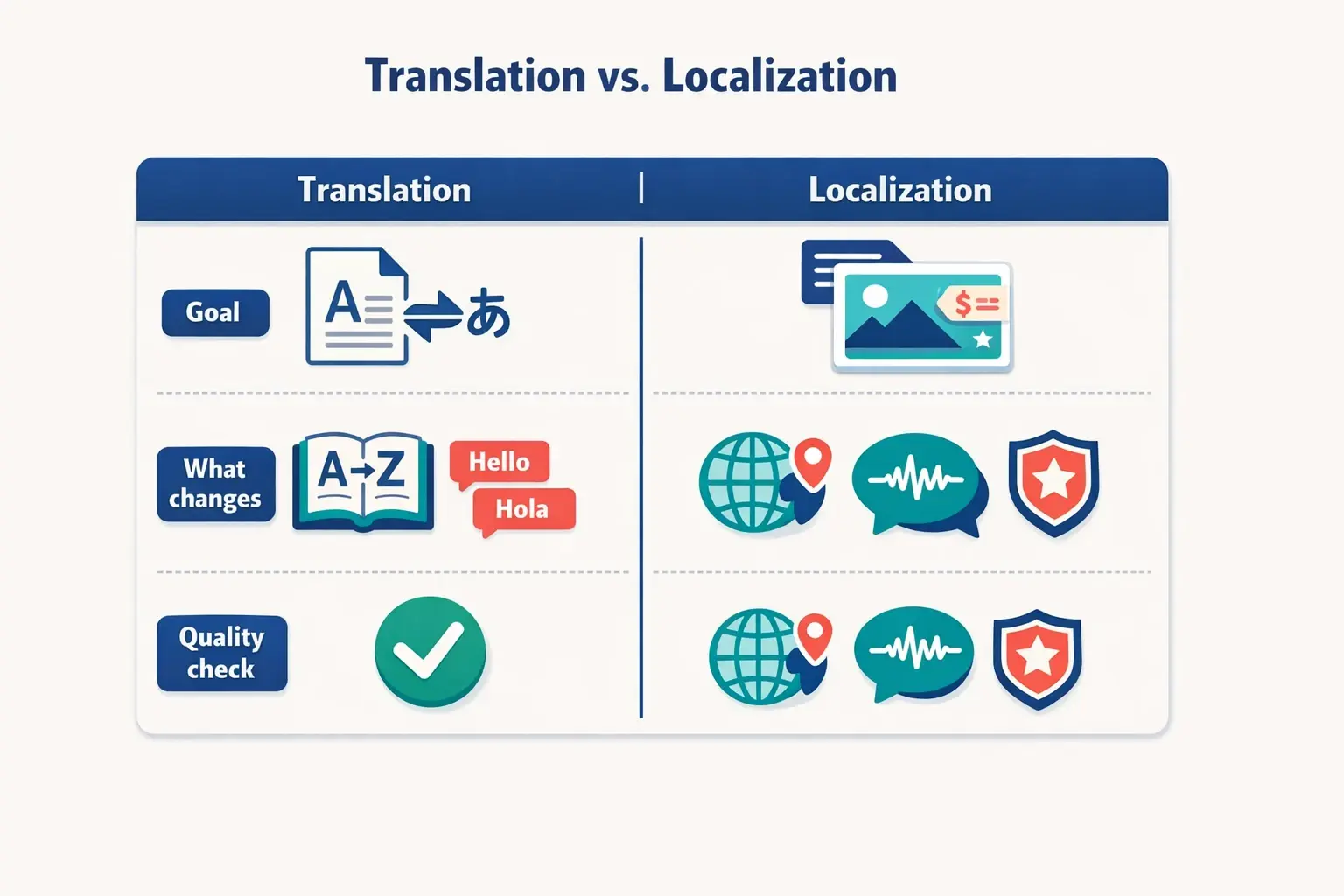
The Foundation: What is AI-Driven Content Localization?
To understand how to fix tone, we first need to understand the machinery. AI-driven content localization goes far beyond the basic word-replacement algorithms of the past. It leverages Large Language Models (LLMs), Neural Machine Translation (NMT), and Machine Learning (ML) to analyze context, sentiment, and intent.
Basic translation asks, “What is the exact word in Spanish?” AI localization asks, “How would a native Spanish speaker express this underlying emotion?”
Current AI models achieve this by identifying patterns in massive datasets of human language. However, while these tools are exceptionally fast and cost-efficient for scaling, they don’t inherently understand human empathy or regional subtleties unless explicitly guided. They process data, not culture.
The AI “Blind Spots”: Why Tone Drift Happens
Even the most sophisticated AI models have distinct cultural blind spots. When AI attempts to adapt marketing copy without proper guidance, it often falls victim to a phenomenon known as “Tone Drift.”
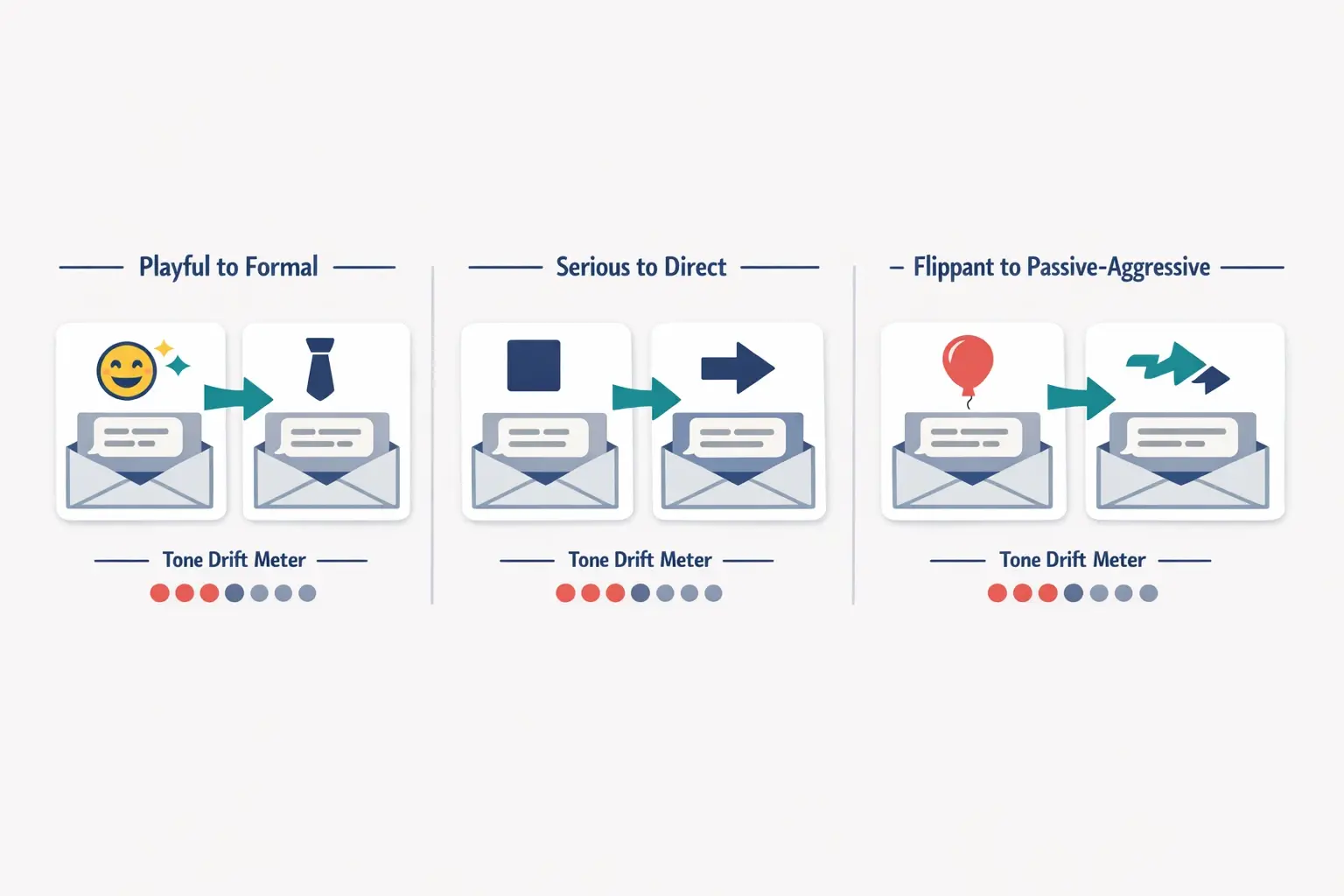
Tone drift occurs when the original emotion of a message morphs into something unintended during the localization process. It is rarely a grammatical error; it is a contextual failure.
Common Causes of Tone Drift
- The Humor Disconnect: Humor is notoriously localized. A pun that crushes in the United Kingdom will likely confuse an audience in Japan. AI often translates the literal setup of a joke, entirely missing the punchline’s cultural context.
- Formality Norms: English doesn’t differentiate between formal and informal “you.” But translating a casual “Hey, you!” into French requires choosing between tu (informal) and vous (formal). Pick the wrong one, and your brand sounds either overly intimate or stiffly corporate.
- Idioms and Metaphors: Telling a Spanish audience that your new software is a “home run” means nothing in a culture where baseball isn’t the dominant sport. AI might literally translate the words, leaving readers baffled.
We see this frequently when businesses try to scale too fast. If you look at ecommerce brands that used growth hacking to enter new global markets rapidly, the ones that succeeded were those that recognized AI’s limitations and adapted their cultural nuances, rather than just blasting translated copy across borders.
Human + AI Synergy: Designing the Modern Localization Workflow
The most common misconception in 2026 is that AI replaces human localization experts. In reality, AI elevates them from translators to cultural editors.
To prevent tone drift, modern marketing teams must build robust, iterative workflows. You cannot simply hand a document to an AI and hope for the best. The most successful framework is the “AI-First, Human-Refined” model.
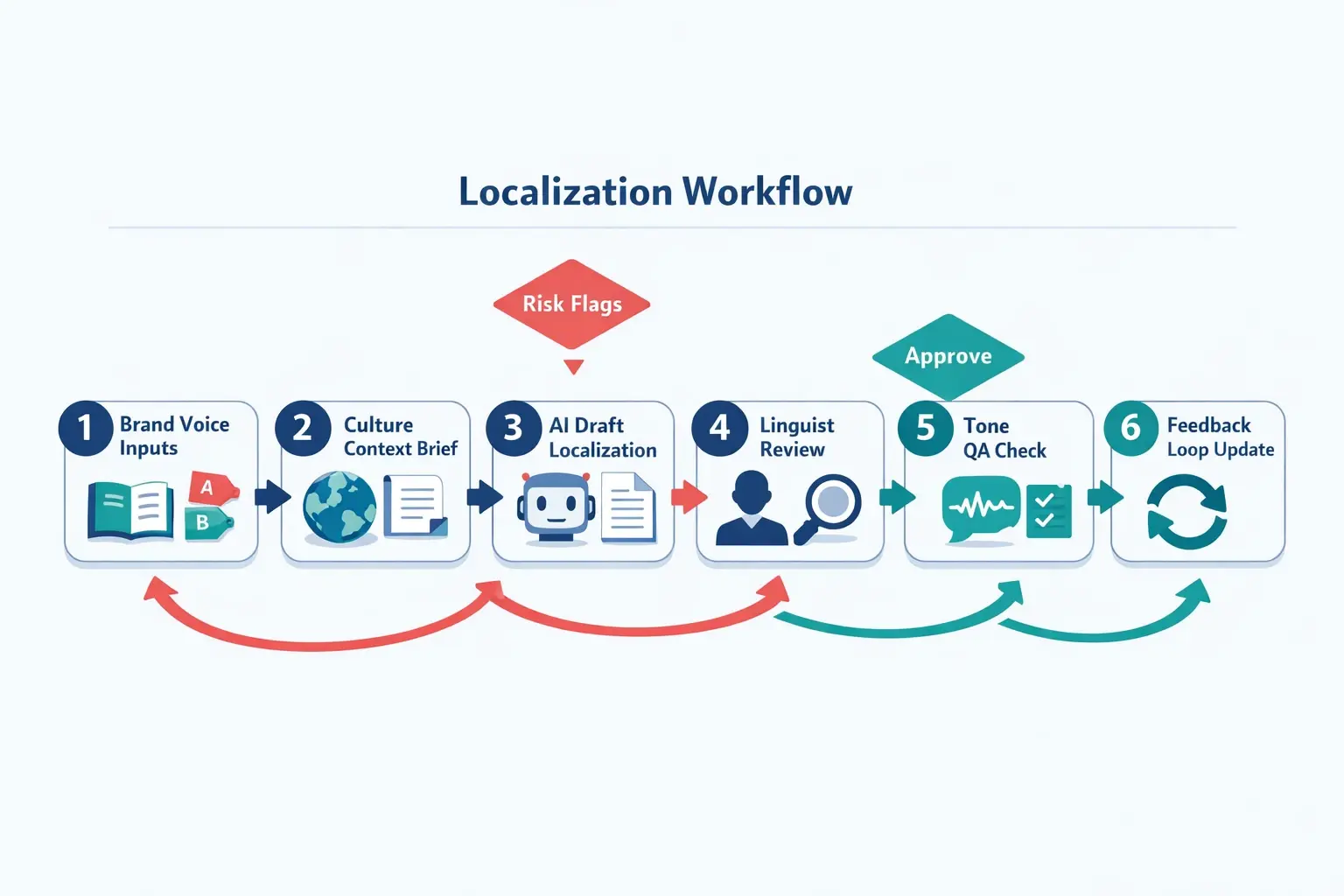
The Blueprint for Tone Preservation
- AI Drafting: The AI processes the bulk translation, handling the heavy lifting of structure, baseline grammar, and initial localization based on pre-defined glossaries.
- Cultural Review: Native-speaking marketers or localizers review the output specifically for cultural resonance, humor, and emotional intent.
- The Feedback Loop: This is the most critical step. When a human corrects a piece of AI-localized content, that correction must be fed back into the system to update the AI’s localized style guide. This prevents the AI from making the same tonal error twice.
Integrating this type of seamless feedback loop into your overarching marketing stack is what separates amateur localization from enterprise-grade cultural adaptation.
Culture-First Prompting: Instructing AI for Nuance
If your AI is producing flat, toneless localization, the problem likely isn’t the tool—it’s your instructions.
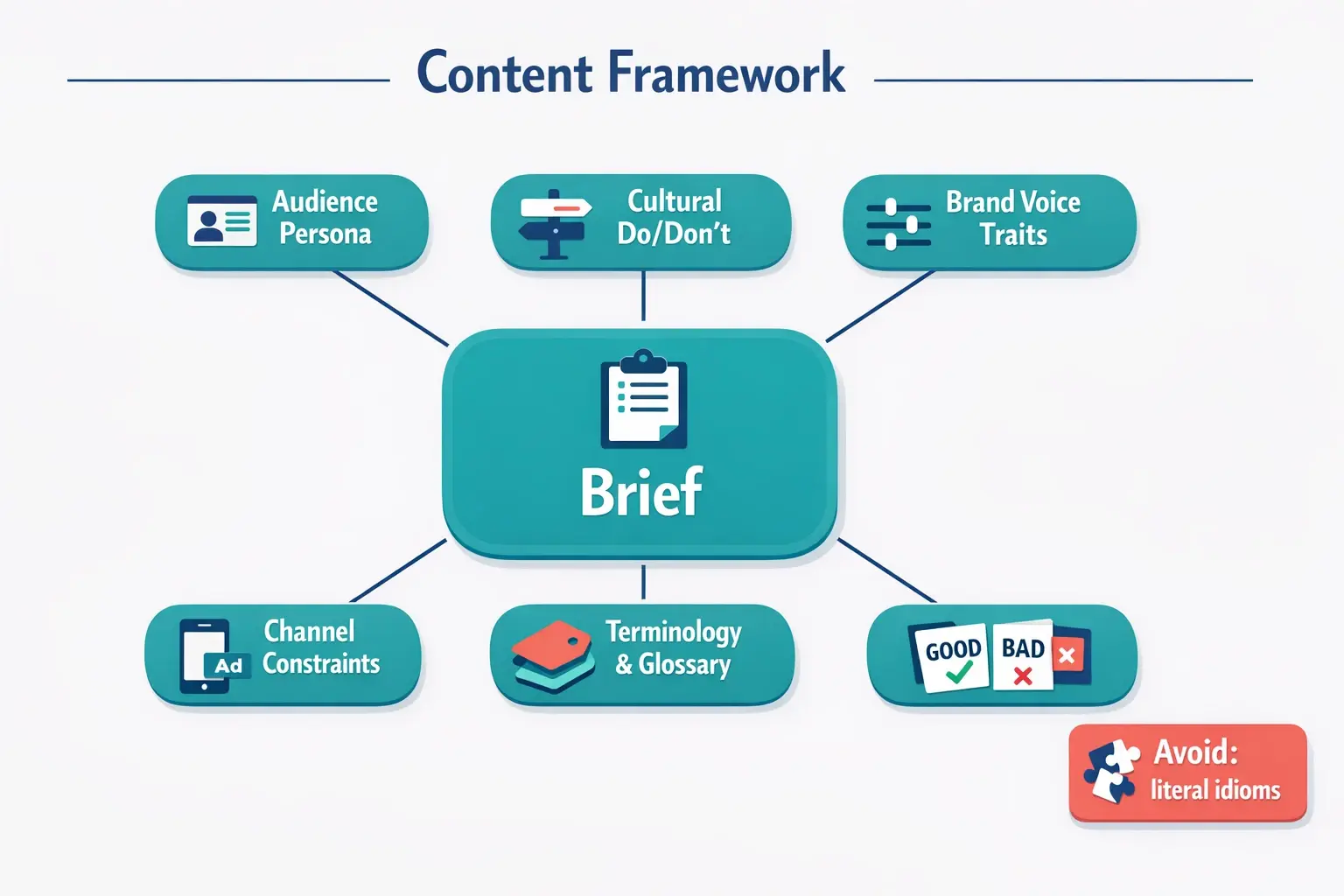
Mastering prompt engineering for marketing is the single biggest lever you can pull to ensure tonal accuracy. Moving from a basic command like “Translate this blog post to Italian” to a “Culture-First Prompt” changes everything.
Anatomy of a Culture-First Prompt
A highly effective localization prompt should act as a comprehensive creative brief for the AI:
- Role Definition: “Act as an expert localized copywriter native to Milan, Italy.”
- Audience Context: “The target audience is Gen Z professionals who value directness but appreciate subtle, dry humor.”
- Brand Voice Parameters: “Maintain a confident and optimistic tone. Avoid overly formal corporate jargon. Do not use direct translations of English idioms; replace them with culturally equivalent Italian phrases that carry the same energetic sentiment.”
- Negative Constraints: “Do not use the formal ‘Lei’; stick to the informal ‘tu’.”
Whether you are localizing landing pages, email sequences, or even community-driven initiatives like quora marketing, treating your AI as a junior copywriter who needs strict cultural guardrails will dramatically reduce tone drift.
Evaluating Success and Ethical Considerations
As marketing ai tools become more autonomous, marketers must establish frameworks to measure tone preservation at scale.
You can no longer rely solely on “error rates” to judge translation quality. Instead, modern teams use frameworks like DQF-MQM (Dynamic Quality Framework – Multidimensional Quality Metrics), which allows evaluators to score content specifically on “fluency” and “cultural appropriateness.”
Furthermore, ethical AI localization requires us to be mindful of cultural homogenization. If we over-rely on standard AI models, we risk flattening beautiful regional dialects into a generic, “globalized” voice. True localization celebrates diversity; it doesn’t erase it.
Frequently Asked Questions (FAQ)
What is the difference between AI translation and AI localization?
Translation focuses on converting text from one language to another word-for-word. AI localization adapts the entire message—including cultural references, idioms, humor, and formatting—so it feels natively crafted for the target audience.
Will AI completely replace human localization experts?
No. While AI handles the heavy lifting of scale and speed, human experts are critical for “cultural QA.” AI struggles with deep emotional nuance, satire, and rapidly changing internet culture. The most successful strategy is a hybrid workflow where AI drafts and humans refine.
How can I stop AI from losing my brand’s humor?
Humor rarely translates directly. You must use “Culture-First Prompting” to instruct the AI not to translate the joke, but to replace the joke with a culturally relevant equivalent that evokes the same emotion in the target region.
What is “Tone Drift”?
Tone drift happens when the intended emotion or personality of a message changes during translation. For example, a casual, friendly English email might inadvertently translate into a cold, demanding email in German due to differing cultural standards of formality.
How do I maintain consistency across multiple languages?
Develop AI-specific localization assets. This includes creating localized style guides, comprehensive glossaries that define how key brand terms should be treated in different regions, and a centralized database of approved prompts for your AI tools.
Next Steps for Global Marketers
As AI continues to reshape the landscape of international business in 2026, the brands that win globally will be the ones that sound like locals everywhere.
Start by auditing your current localized content. Are you simply translating words, or are you adapting your voice? Take the time to build robust, culture-first prompts, establish a solid human-in-the-loop workflow, and prioritize nuance over sheer speed.
For more actionable strategies, tool breakdowns, and deep dives into building a resilient, future-proof marketing ecosystem, explore our curated resources at Swipe Directory. Because in the era of AI, your message is only as powerful as your ability to connect with the human on the other side of the screen.