
If you are currently evaluating AI marketing analytics platforms, you already know the era of looking in the rearview mirror is over. The dashboard showing what your customers did last week is no longer a competitive advantage. Today, the mandate is clear: you need to know what they are going to do tomorrow.
But as you sit through vendor demos promising the moon with “AI-powered insights,” the real questions start surfacing. Does switching from your current rules-based segmentation to predictive clustering justify the integration cost? How do you ensure the algorithms aren’t a regulatory nightmare in a privacy-first, cookie-less landscape? And perhaps most importantly, how do you explain the AI’s “Black Box” decisions to your executive team when millions of dollars in ad spend are on the line?
Let’s cut through the speculative hype. In 2026, implementing AI marketing analytics is less about chasing buzzwords and more about practical, scientifically backed methodology. This guide bridges the gap between high-level case studies and technical product documentation, giving you the exact framework needed to confidently evaluate, select, and deploy predictive marketing platforms.
The 2025-2026 Predictive Shift: From Demographics to Micro-Behaviors
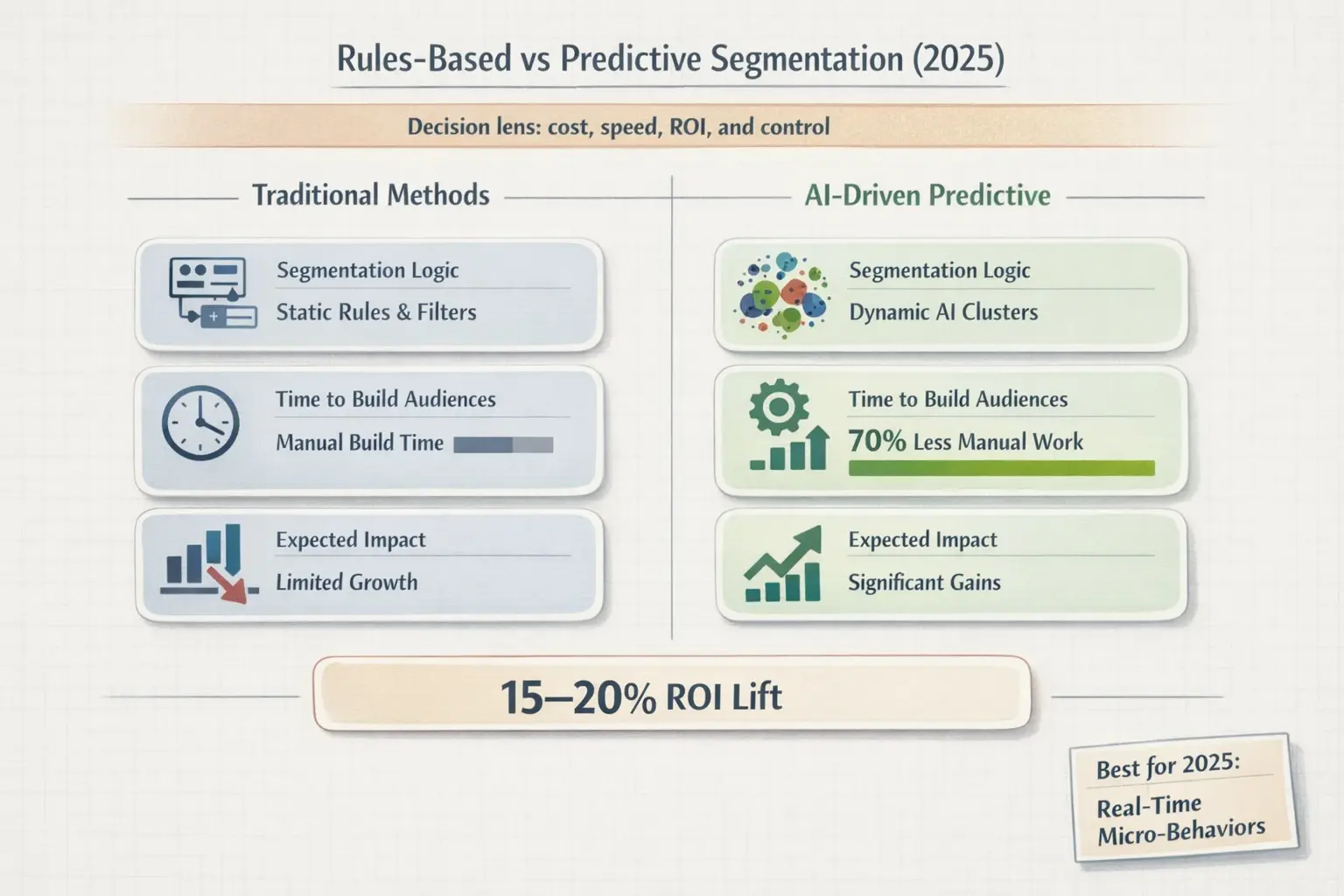
Throughout late 2024 and 2025, we witnessed a massive behavioral shift in how enterprise and mid-market teams handle data. The fundamental limitation of traditional marketing analytics was its reliance on static demographics and historical event triggers. You built an audience based on “purchased in the last 30 days” and hoped for the best.
AI-driven platforms have replaced this with real-time behavioral clustering. Modern tools don’t just look at completed actions; they analyze micro-behaviors. They measure hover time, scroll depth, rage clicks, and the subtle heuristics that indicate intent long before a user hits a checkout page.
By leveraging advanced ML models—specifically K-Means Clustering—these platforms group users based on dynamic similarities rather than static rules. The operational impact here is massive. Recent industry data shows that automated predictive segmentation reduces manual audience building time by a staggering 70%. It frees your team from constantly updating rulesets and allows for true hyper-personalization at scale, laying the foundation for modern growth hacking techniques.
The Synthetic Persona Revolution
As you evaluate tools this year, one feature should be at the top of your required capabilities list: Synthetic Personas.
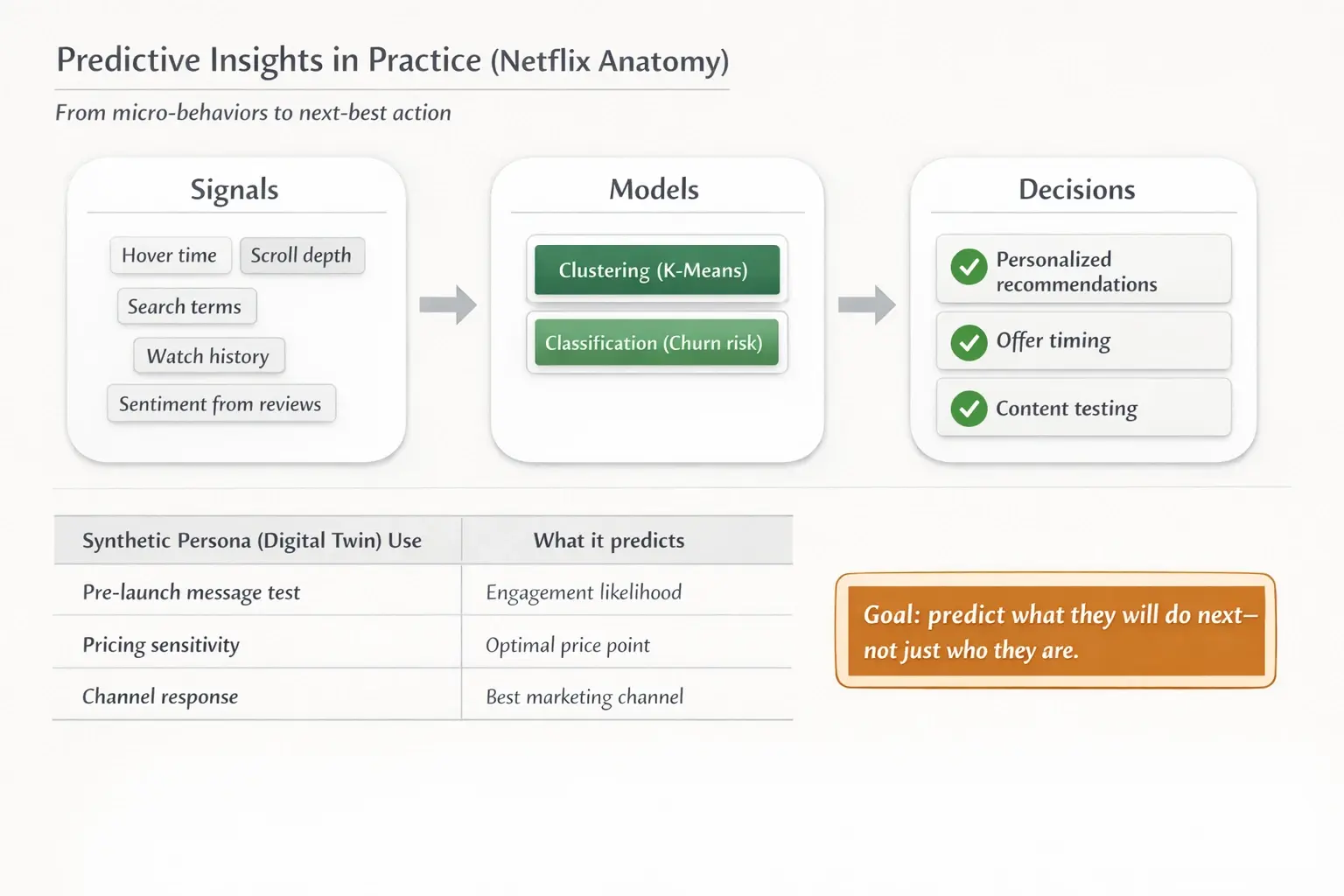
Traditional market research requires weeks of focus groups and A/B testing. But what if you could use AI to simulate customer reactions before launching a campaign? Enter the “Digital Twin” concept. By training Large Language Models (LLMs) on your unstructured data—think chat logs, customer service tickets, social sentiment, and product reviews—you can generate AI proxies of your distinct customer segments.
Want to know how your high-LTV segment will react to a new pricing tier? You ask your synthetic personas. This predictive capability allows teams to safely pre-test messaging, significantly mitigating launch risk. It’s particularly effective when deploying high-stakes growth hacking ecommerce strategies where slight variations in offer framing can dramatically impact conversion rates.
Case Study: The Netflix Predictive Anatomy
When users search for a “North Star” example of predictive success, Netflix is universally the benchmark. But why? It’s not just that they use AI; it’s how they integrate it.
Netflix’s proprietary CRM doesn’t treat analytics as a separate dashboard. Their custom Machine Learning models ingest unstructured behavioral data to drive actionable classification models. They don’t just predict what show you want; they predict which thumbnail image will make you click, effectively automating growth hacking social media techniques on an individualized basis. This unified loop between data ingestion, predictive modeling, and immediate content delivery is exactly what you should look for in off-the-shelf B2B or B2C platforms today.
Decoding the “Black Box”: Trust, Transparency, and Privacy
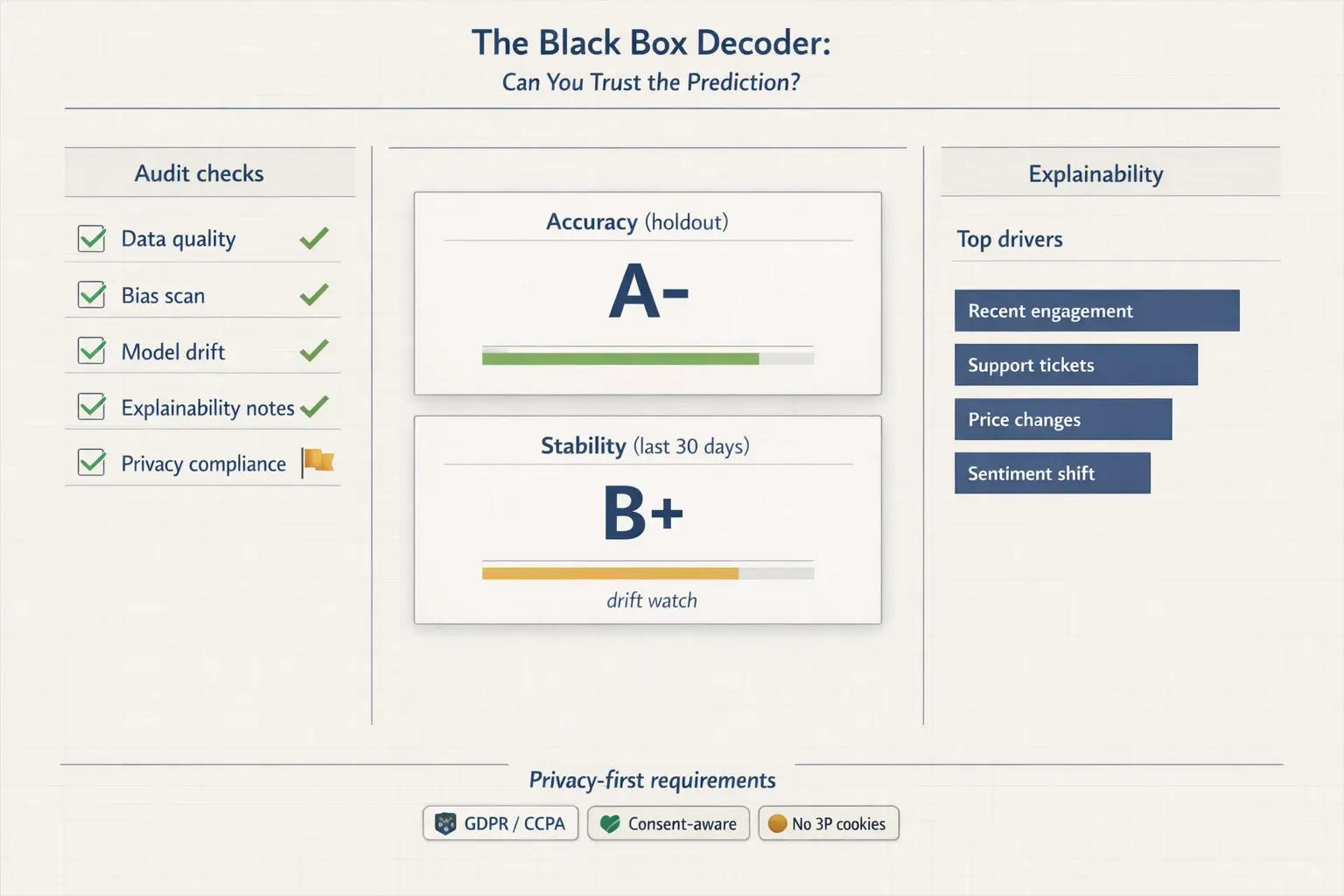
Here lies the biggest objection during the evaluation stage: the “Black Box” problem. Marketing managers often struggle to trust AI predictions when they can’t explain the logic to their data science teams or the C-suite. If an AI platform tells you to cut ad spend in a specific demographic, you need to know why.
When comparing platforms, demand Explainable AI (XAI) capabilities. The best tools don’t just give you a prediction; they provide a list of the top contributing data points that led to that prediction.
The Privacy-First Imperative
Explainability goes hand-in-hand with compliance. In 2026, running predictive analytics without third-party cookies isn’t optional; it’s the law. Your chosen platform must utilize a privacy-first predictive framework that relies strictly on zero-party and first-party data.
The stakes are highest in regulated industries. For example, healthcare growth hacking agencies rely heavily on predictive analytics to forecast patient needs, but the data must be rigorously anonymized. We see similar compliance demands when applying growth hacking for therapy practices or mapping out broader healthcare network growth strategies. If an AI analytics tool cannot seamlessly adhere to HIPAA, GDPR, or CCPA by keeping sensitive identifiers out of the predictive modeling layer, it should be immediately disqualified from your shortlist.
MOFU Buyer’s Guide: 5 Criteria for Choosing an AI Analytics Platform
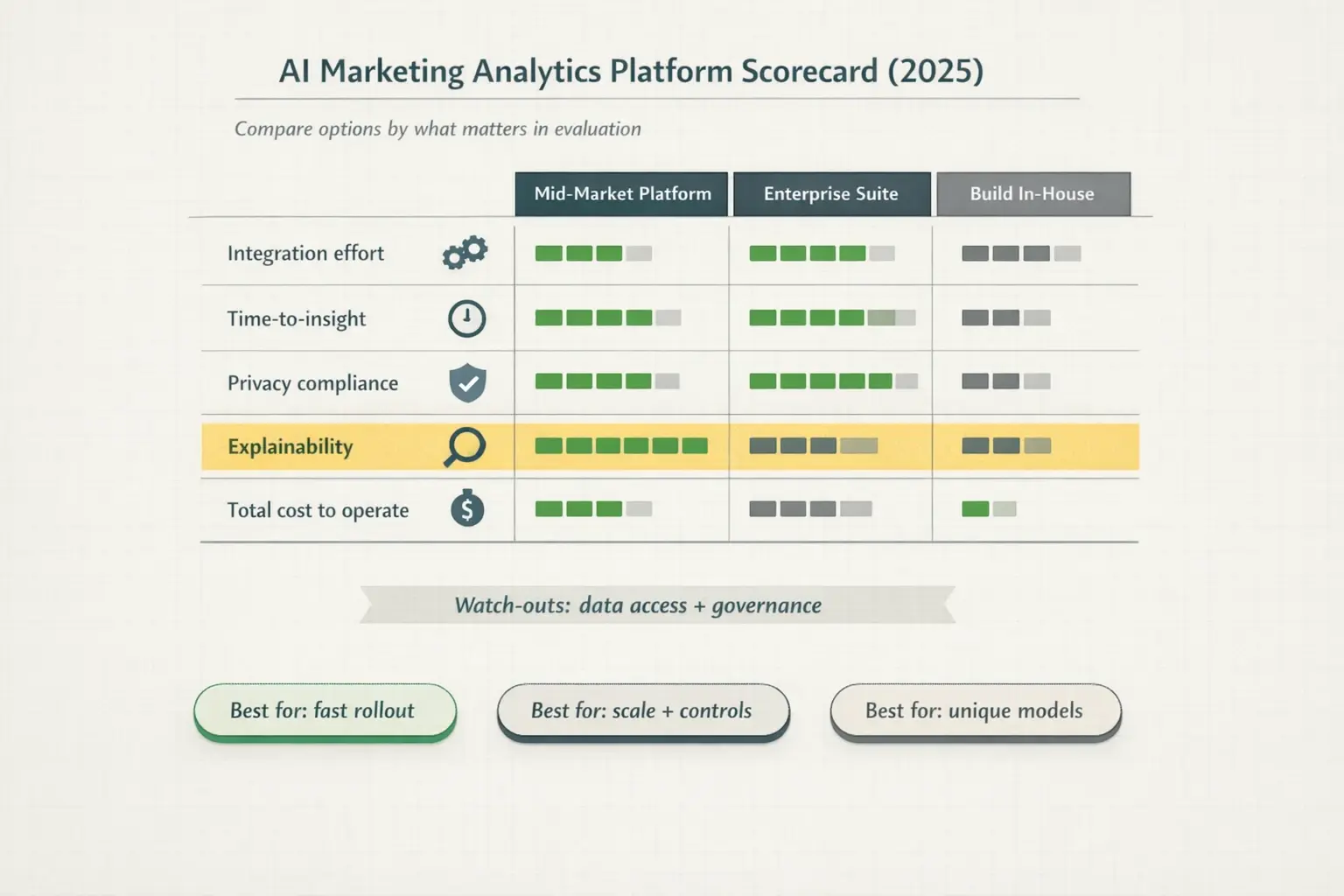
To move from evaluation to confident selection, grade your shortlisted vendors against these five critical benchmarks:
- Time-to-Insight & Integration: Does the platform natively connect to your existing CRM and CDP, or will it require a six-month engineering sprint? Look for out-of-the-box integrations.
- Churn Prevention Accuracy: Ask for their case studies on identifying “silent quitters.” Top-tier AI-driven churn prediction models are currently achieving up to a 25% reduction in customer attrition by flagging at-risk users 30 days before they actually cancel.
- Unstructured Data Capabilities: Can the tool read sentiment in customer chat logs and reviews using LLMs, or is it limited to quantitative clicks?
- Explainability: Will the platform allow marketing managers to “talk” to the data and understand the algorithmic weightings?
- Measurable Lift: Adopters of mature predictive analytics report a 15-20% increase in marketing ROI through optimized spend allocation. Ask vendors to prove how their clustering directly impacts ROAS.
Frequently Asked Questions (Overcoming Internal Objections)
How do we justify the cost of an AI predictive suite over our free legacy analytics?Legacy analytics tell you what money you’ve already lost. Predictive analytics identify revenue opportunities and churn risks before they impact the bottom line. The 15-20% average increase in marketing ROI typically covers the platform cost within the first two quarters of implementation.
Do we need a dedicated data science team to use these platforms?No. The defining feature of 2026’s top AI platforms is their “no-code” usability. Modern solutions are designed specifically for marketing teams, featuring natural language querying where you can literally ask, “Which customer segment is most likely to buy our new product next week?”
What happens if the model suffers from ‘data drift’?Data drift occurs when consumer behavior changes unexpectedly, rendering old predictions inaccurate. Top platforms combat this through continuous learning loops. During your vendor evaluation, specifically ask how their platform monitors and alerts users about data drift to maintain prediction accuracy over time.
Next Steps for Strategic Implementation
Transitioning to AI-driven marketing analytics isn’t just a technology upgrade; it is a structural shift in how your company anticipates market demands. By focusing on micro-behaviors, leveraging synthetic personas for risk-free testing, and demanding transparent, privacy-first models, you position your marketing team as a proactive revenue engine rather than a reactive reporting center.
To take the next step in your evaluation journey, explore our curated directory of vetted, unbiased resources. Compare the highest-rated tools, read deep-dive implementation guides, and find the specific predictive platform that aligns with your current tech stack and 2026 growth goals.