
Imagine staring at a spreadsheet containing 10,000 newly updated product SKUs. The manufacturer has kindly provided the raw specs: dimensions, materials, and weights. But the “Description” column? It’s completely empty.
If you’re managing an online store in 2026, you know this feeling intimately. Writing unique, compelling, and SEO-optimized copy for that many products manually isn’t just daunting; it’s a mathematical impossibility without a massive—and expensive—content team. Conversely, simply copy-pasting the manufacturer’s generic descriptions is a one-way ticket to search engine obscurity due to duplicate content penalties.
For years, e-commerce retailers were stuck in this “messy middle,” forced to choose between scale and quality. Today, Artificial Intelligence has thrown the industry a lifeline, but finding success requires more than just asking a chatbot to “write a description for a blue shirt.” Let’s explore how the savviest retailers are turning raw data into persuasive, rank-worthy product copy at an unprecedented scale.
The Core Concept: Demystifying AI for E-commerce
When beginners search for ways to scale copy, they usually start by asking, “What exactly is an AI product description generator?”
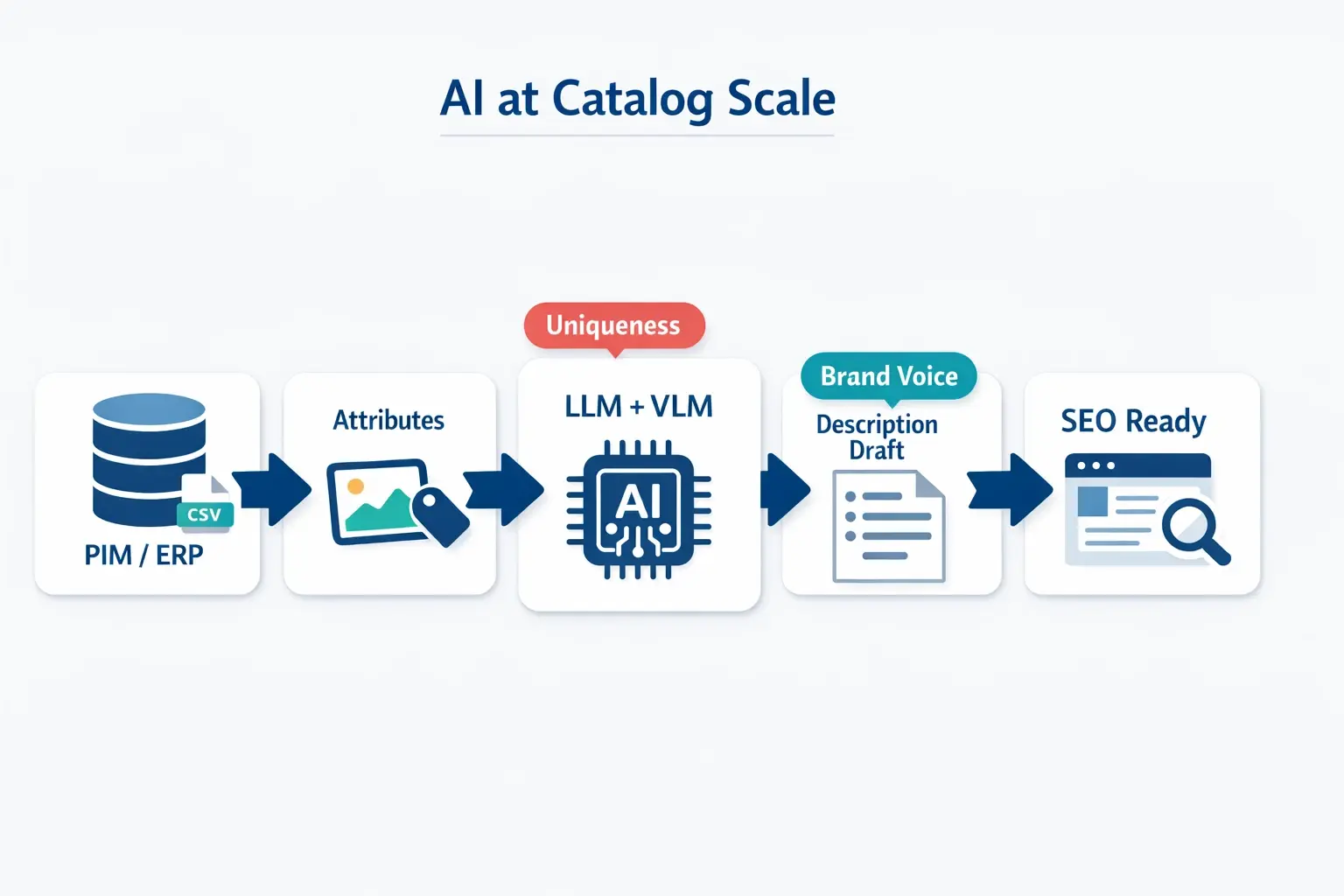
At its core, it is software powered by Large Language Models (LLMs). These models have ingested vast amounts of text and learned how to predict the next logical word in a sequence based on the parameters (prompts) you provide. In 2026, we’re also seeing the rise of vision-language models—AI that can “look” at a product image and automatically describe its visual features, combining that insight with your technical specs.
But the real magic happens when AI moves from being a simple text generator to a fully integrated part of your marketing stack. By plugging AI directly into your product workflows, you transform it into a powerful synthesizer. It takes dry, scattered data points and weaves them into a cohesive story that speaks directly to your ideal customer’s pain points.
Choosing the Right Tools for Catalog-Scale Copy
The educational landscape is flooded with “Top 10” lists, but picking the right tool isn’t about finding the smartest AI; it’s about finding the best fit for your workflow.
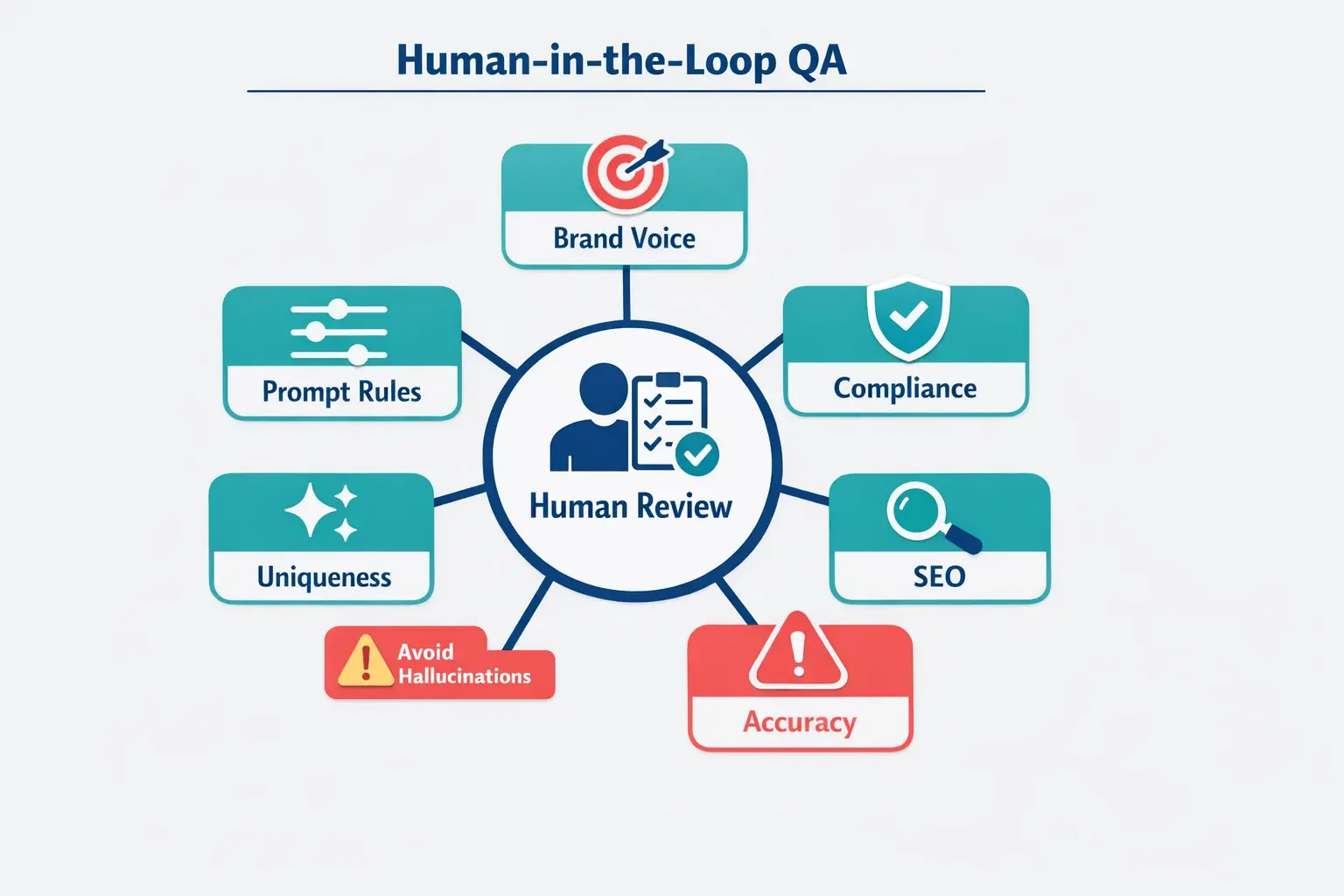
Here is a breakdown of how different AI solutions serve different e-commerce needs:
1. Spreadsheet-Native AI (e.g., Numerous.ai)
- Best for: Small to medium businesses with highly organized CSVs.
- How they work: These tools live right inside Google Sheets or Excel. You use formulas (like
=AI("Write a description based on these features", A2)) to generate copy down a column of thousands of rows instantly. - The Catch: They require you to be very comfortable manipulating spreadsheets and might lack deep, direct integrations with complex store backends.
2. Purpose-Built E-commerce Generators (e.g., Describely)
- Best for: Shopify and BigCommerce users who want an out-of-the-box solution.
- How they work: These platforms are designed explicitly for retail. They often sync directly with your store, allowing you to establish specific rulesets for formatting, keyword density, and tone of voice.
- The Catch: They can sometimes feel rigid if you have highly unconventional products that require heavy narrative storytelling.
3. Enterprise PIM Integrations
- Best for: Large retailers using Product Information Management (PIM) systems or ERPs.
- How they work: Custom API integrations that allow headless AI models to pull data from multiple databases, write the copy, and push it live with automatic translations and regional localizations.
- The Catch: High implementation costs and significant development time.
The “Human-in-the-Loop” Blueprint: Prompt Engineering & QA
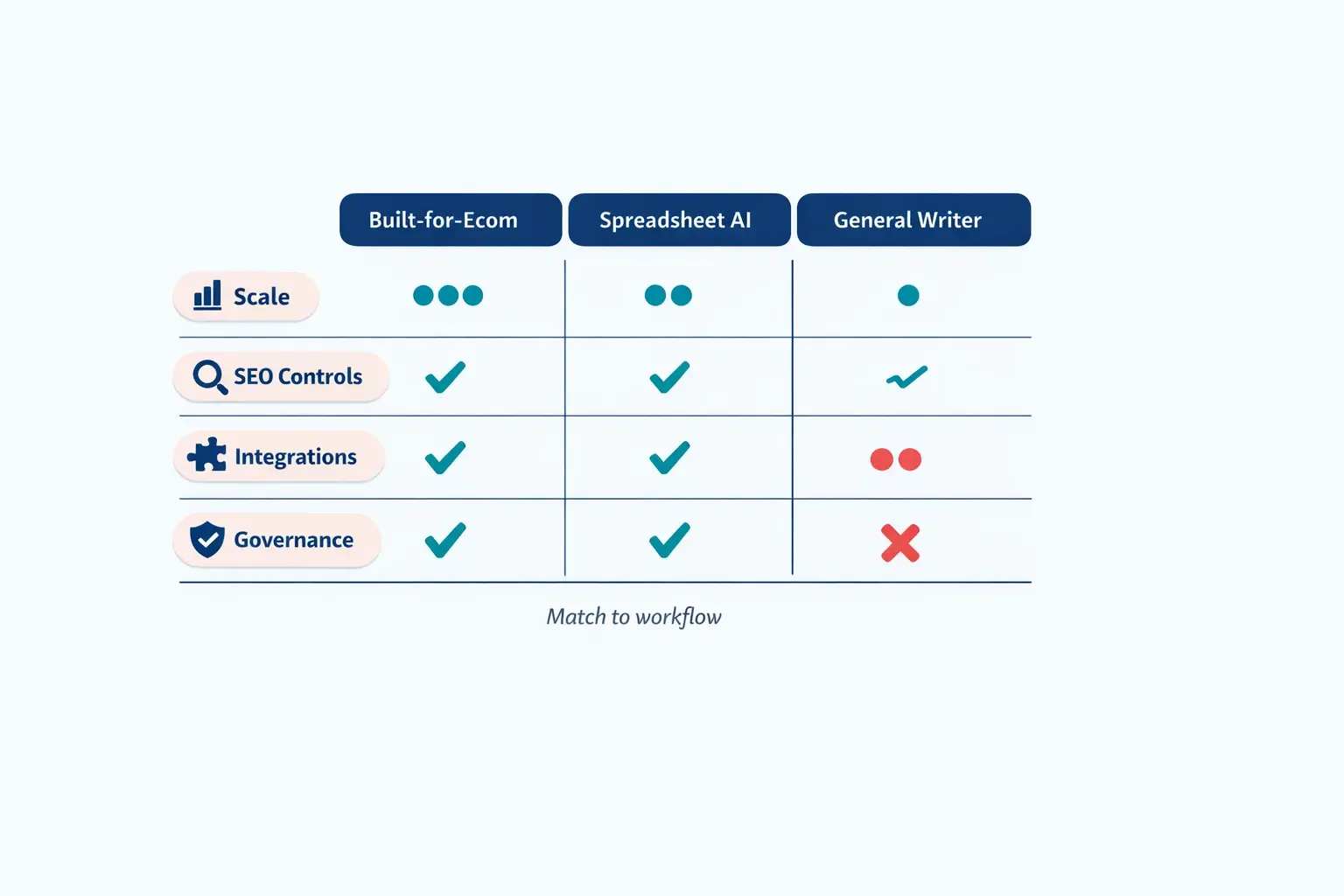
The biggest misconception about AI product descriptions is that they are “set it and forget it.” If you leave AI entirely unchecked, you will inevitably end up with generic fluff (“Elevate your wardrobe with this stunning piece!”), or worse, AI “hallucinations” where the software invents features your product doesn’t actually have.
The secret to scaling quality is the Human-in-the-Loop (HITL) methodology. Humans shouldn’t be writing the copy from scratch anymore; they should be acting as editors and directors.
Mastering the Prompt
The quality of your output is entirely dependent on the quality of your input. Relying on basic commands leads to basic copy. To get unique, on-brand descriptions, you need to master prompt engineering for marketing.
A scalable, high-quality prompt framework usually includes:
- Role Designation: “Act as a senior e-commerce copywriter for an outdoor adventure brand.”
- Target Audience: “The audience is millennial hikers looking for lightweight, durable gear.”
- Data Inputs: “[Insert Product Name], [Insert Specs], [Insert Primary Keyword].”
- Formatting Rules: “Write one 50-word engaging paragraph highlighting the main benefit, followed by 5 bullet points focused on technical specs.”
- Negative Constraints: “Do not use words like ‘innovative,’ ‘stunning,’ or ‘game-changer.’ Do not invent features not listed in the specs.”
Establishing Quality Assurance Checkpoints
When generating descriptions at scale, you can’t read every single one. Instead, set up a structured review process:
- Batch Testing: Generate 50 descriptions first. Review them manually to identify patterns where the AI deviates from your brand voice. Adjust the prompt before generating the remaining 9,950.
- Automated Flagging: Use secondary scripts to flag descriptions that are too short, too long, or missing your target SEO keywords.
- The “Accuracy Audit”: Have your product team randomly audit 5% of the AI outputs solely to check for factual accuracy and compliance, keeping your marketing ai operations reliable and trustworthy.
Proving the Value: ROI, A/B Testing & Performance Measurement
Historically, content creation was viewed purely as a cost center. When adopting AI, the immediate benefit most retailers cite is “time saved.” While reducing a three-month catalog update to three days is incredible, true ROI goes much deeper.
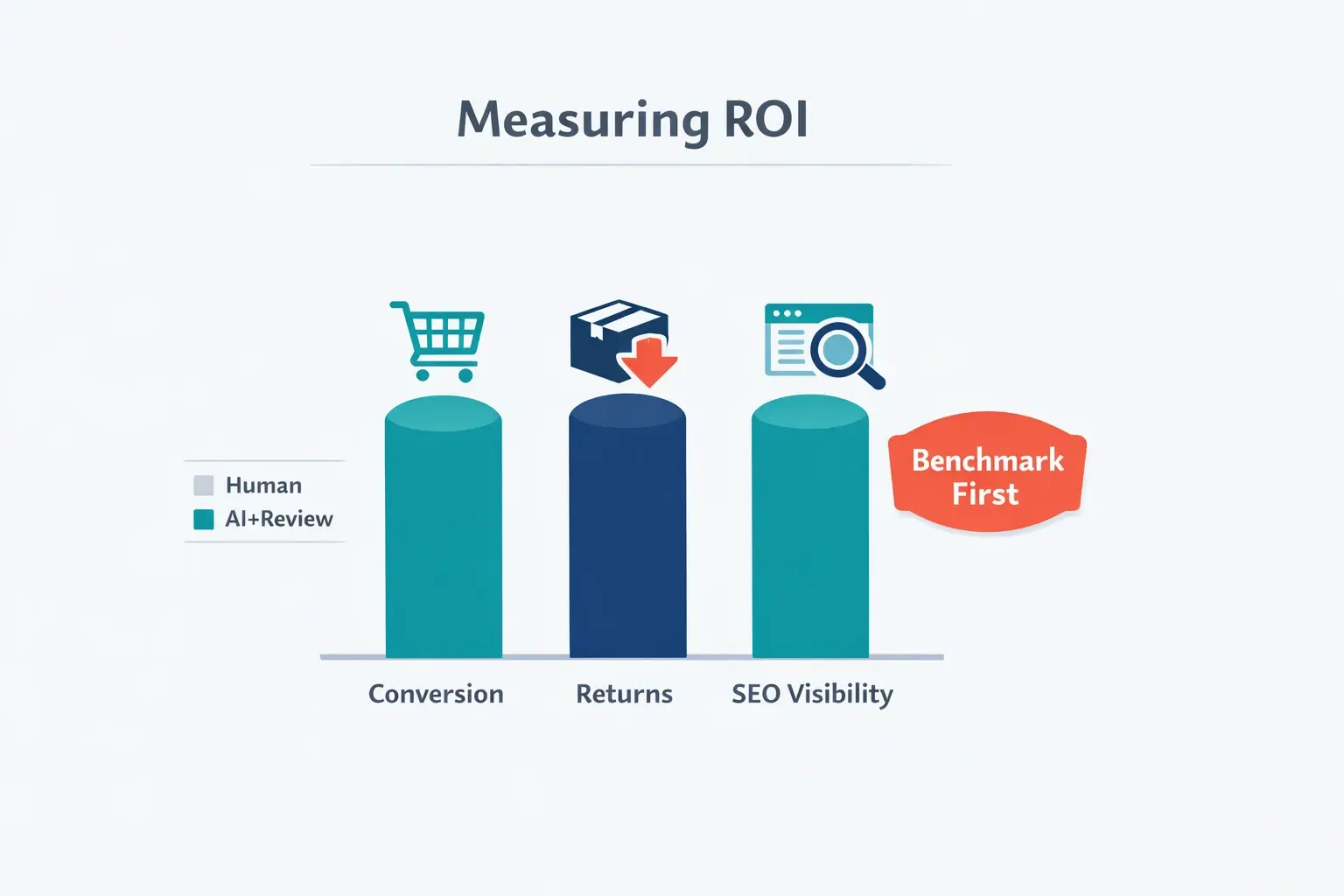
To truly measure the success of your AI implementation, you need to track how the copy impacts the bottom line. This is a core component of modern growth hacking ecommerce.
Benchmarking Success Metrics
- Conversion Rate Lift: Better descriptions answer customer objections before they arise. Run A/B tests on your highest-traffic product pages: your old, human-written copy versus newly optimized, AI-generated-but-human-edited copy.
- Return Rate Reduction: Highly accurate, specific descriptions ensure the customer knows exactly what they are buying. A decrease in returns citing “item not as described” is a massive win for your AI workflow.
- SEO Visibility: By using AI to naturally integrate long-tail keywords and semantic variations across thousands of pages, you should see a measurable lift in organic impressions and rankings over a 90-day period.
Frequently Asked Questions (FAQ)
Are AI-generated product descriptions bad for SEO?
Not inherently. Search engines like Google prioritize helpful, original content that satisfies user intent. If your AI is just spinning generic manufacturer descriptions, your SEO will suffer. If you are using AI to synthesize specs into unique, detailed, and highly readable copy that answers user questions, search engines will reward it.
How do I maintain my brand voice when using AI at scale?
Brand voice drift is a common issue. You combat this by creating a robust “brand voice ruleset” within your prompts. Feed the AI 5-10 examples of your best-performing, human-written descriptions and instruct it to mimic the tone, sentence structure, and vocabulary choices found in those examples.
What are the legal implications of using AI content?
The legal landscape around AI and copyright is continually evolving. Currently, purely AI-generated text cannot be copyrighted by the user. Furthermore, you must ensure your AI tool isn’t inadvertently plagiarizing trademarked phrases. This is why the human review step is legally protective, not just stylistically necessary.
Next Steps for E-commerce Marketers
Scaling your product descriptions with AI is no longer a futuristic concept; it is the baseline expectation for competitive e-commerce operations in 2026.
By understanding the underlying technology, choosing a tool that fits your workflow, mastering your prompts, and enforcing rigorous human quality control, you can turn a monumental chore into a strategic growth lever. Your products deserve to be found, and your customers deserve to understand exactly what they’re buying. AI is simply the engine that gets you there faster.