
Imagine staring at a blank screen, a campaign deadline looming, and the overwhelming pressure to produce yet another high-performing video asset. We’ve all been there. In 2026, video isn’t just a slice of your marketing pie—it is the entire plate. From short-form social ads to deep-dive product explainers, the demand for video content is insatiable.
But here is the universal marketer’s dilemma: while video distribution has never been easier, the pre-production process—specifically scripting and storyboarding—remains a notorious bottleneck.
Enter AI-powered video script generation.
You’ve likely played around with an AI chatbot, asking it to write a quick social caption or draft an email. But using AI to orchestrate a full-fledged marketing video, complete with visual cues, pacing, and storyboarding? That requires a completely different playbook.
This guide dives into the specific use case of AI in streamlining video content production. We’ll show you how to move from a raw idea to a polished script, and finally, to a visual storyboard—bridging the gap between artificial intelligence and human creativity.
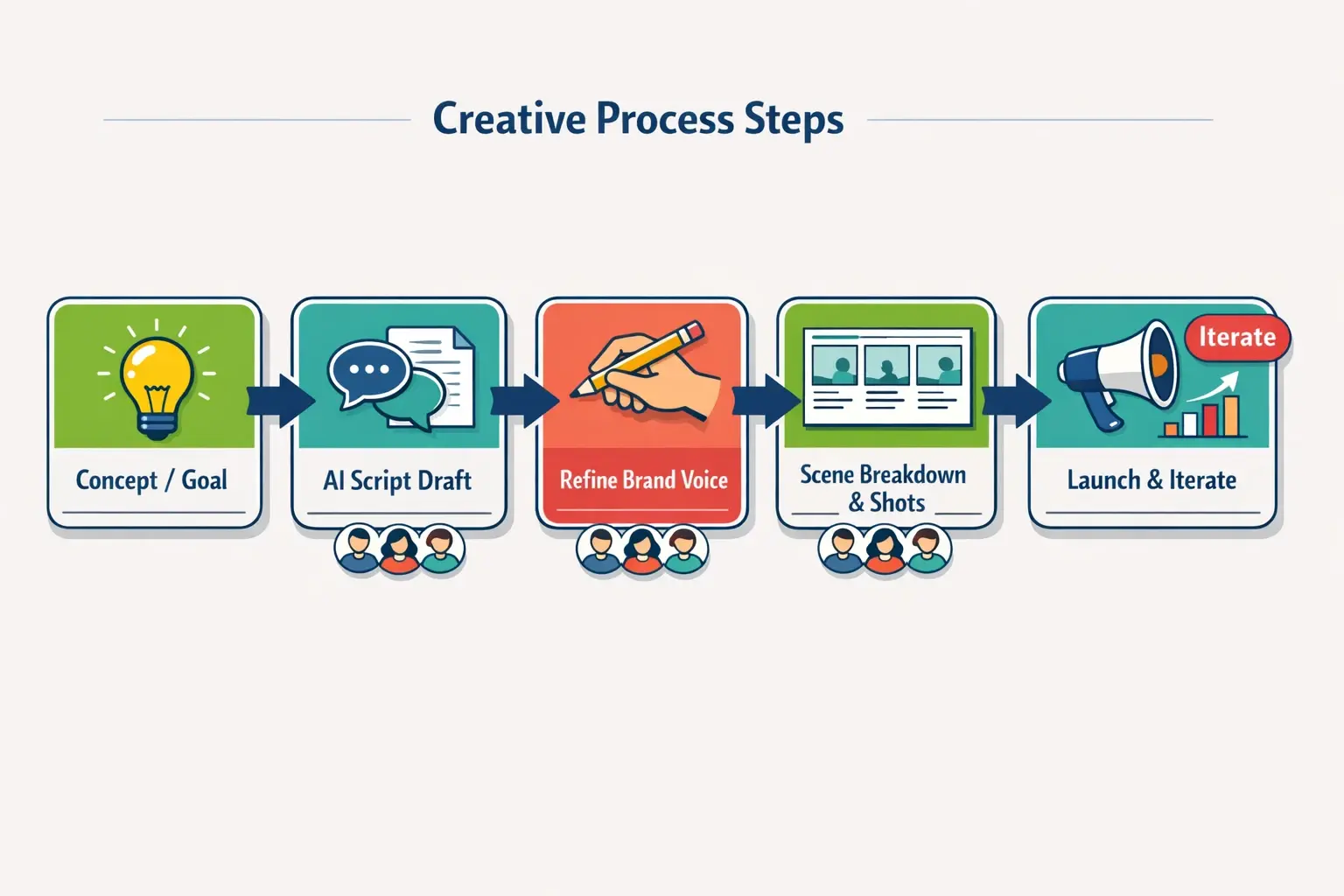
Demystifying AI in Video Content Production
Before we start building, let’s clear the air. What actually is an AI video script generator?
At its core, it’s a platform powered by Large Language Models (LLMs) and Natural Language Processing (NLP). Instead of just spitting out words, these advanced models are trained to understand narrative arcs, pacing, and persuasive language.
However, the biggest misconception in marketing today is that AI is an “autopilot” feature. It’s not. It is a co-pilot.
If you rely on AI to do 100% of the work, you will fall into the “Vanilla Void”—that terrible place where content sounds like everyone else and resonates with no one. The magic happens in a hybrid workflow: AI handles the heavy lifting of structure, formatting, and ideation, while you inject the strategic nuance, emotional resonance, and brand authenticity.
Building: From Concept to AI-Generated Script (The Marketer’s Guide)
A great video doesn’t start with a script; it starts with a strategy. Before you even open your AI tool, you need to lock down two things: your exact marketing objective and your target audience’s deepest pain points.
Once those are set, it’s time to talk to your AI. The quality of your script is directly proportional to the quality of your prompt.
The Art of the Marketing Prompt
Telling an AI, “Write a 30-second script for a new running shoe,” is going to get you a generic output. To get gold, you need to master prompt engineering for marketing.
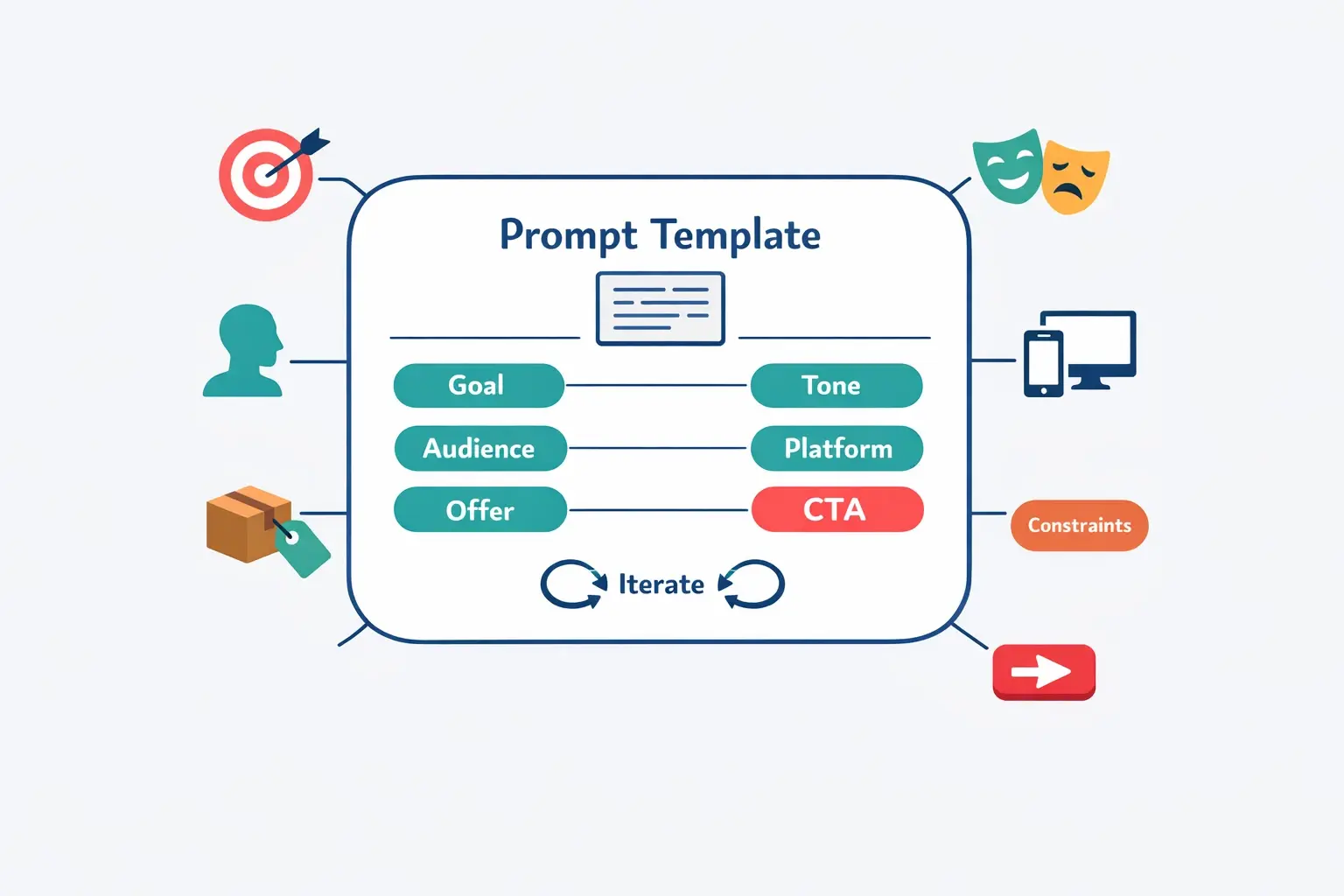
A high-converting prompt should always include:
- The Persona: Who is the AI acting as? (e.g., “Act as a direct-response copywriter…”)
- The Target Audience: Who are we talking to? Be specific about demographics and psychographics.
- The Core Problem & Solution: What pain point does this video solve?
- The Tone/Brand Voice: Is your brand cheeky and disruptive, or authoritative and calm?
- Platform Constraints: Is this a YouTube pre-roll ad (needs a hook in 5 seconds) or a TikTok video?
- The Call-to-Action (CTA): What exactly should the viewer do next?
By applying these constraints, you tap into powerful growth hacking social media techniques that rely on highly targeted, platform-native messaging.
Mastery: Refining & Visualizing – The AI-Assisted Storyboard
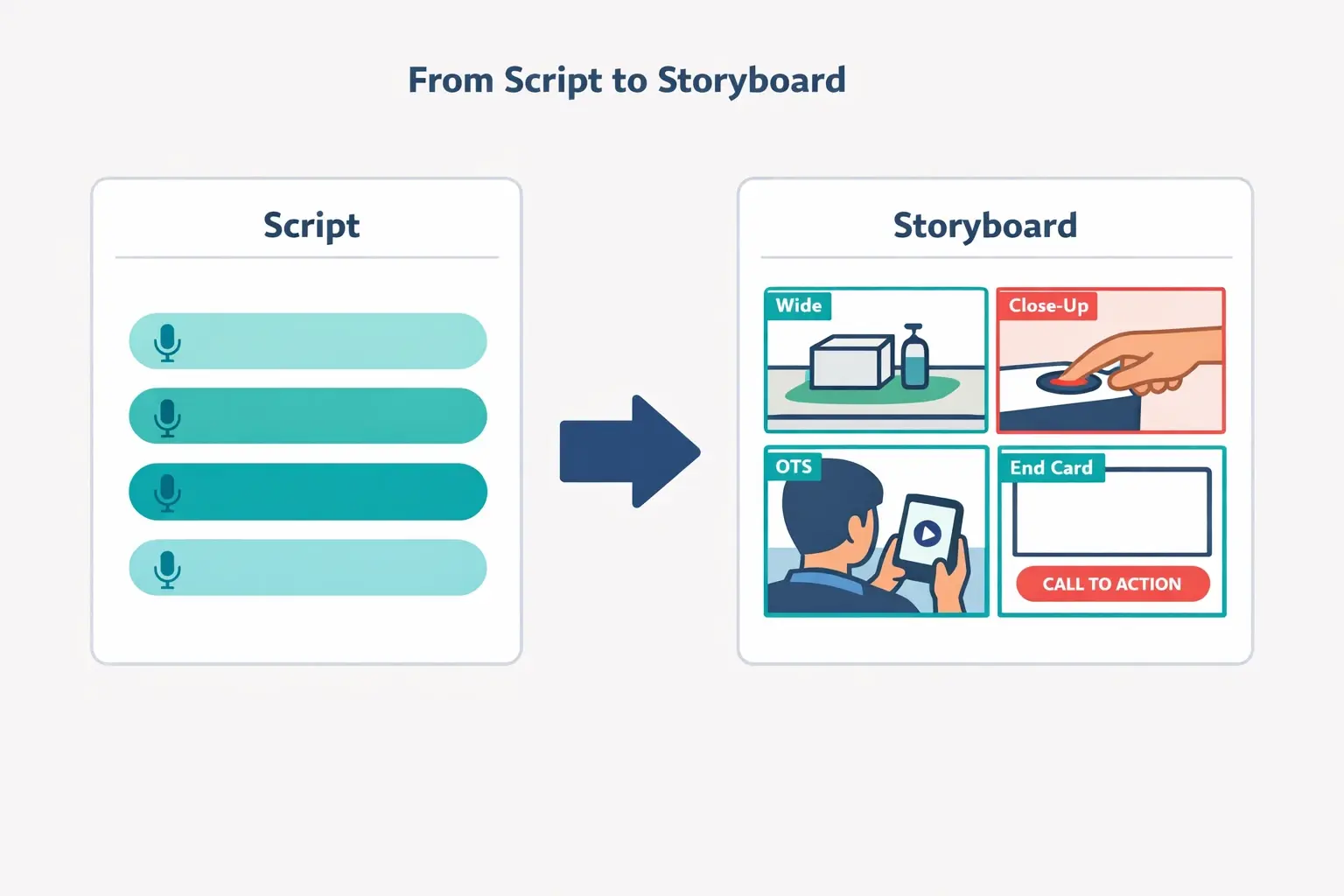
This is where most content creators stop. They have a script, and they try to jump straight to filming. But the true superpower of AI in 2026 is its ability to help you translate words into a visual storyboard.
A script is what is said. A storyboard is what is seen.
Translating Text to Visuals
Once your script is refined, you can use a secondary prompt to ask the AI to break the script down into a two-column Audio/Visual storyboard.
Prompt Example: “Take the script above and format it into a storyboard table. Column 1: Scene Number. Column 2: Specific Visual Cues (suggest shot types like close-up, wide shot, b-roll footage, and on-screen text). Column 3: The corresponding audio/dialogue.”
This explicit process of visualizing the script allows your video editors, designers, and copywriters to work from a unified source of truth. When you look at the rapid scale achieved by modern ecommerce brands that used growth hacking, their secret is often this exact structured visualization process, allowing them to test dozens of ad creatives per week.
Overcoming the “Vanilla Void”: AI Failures & Fixes
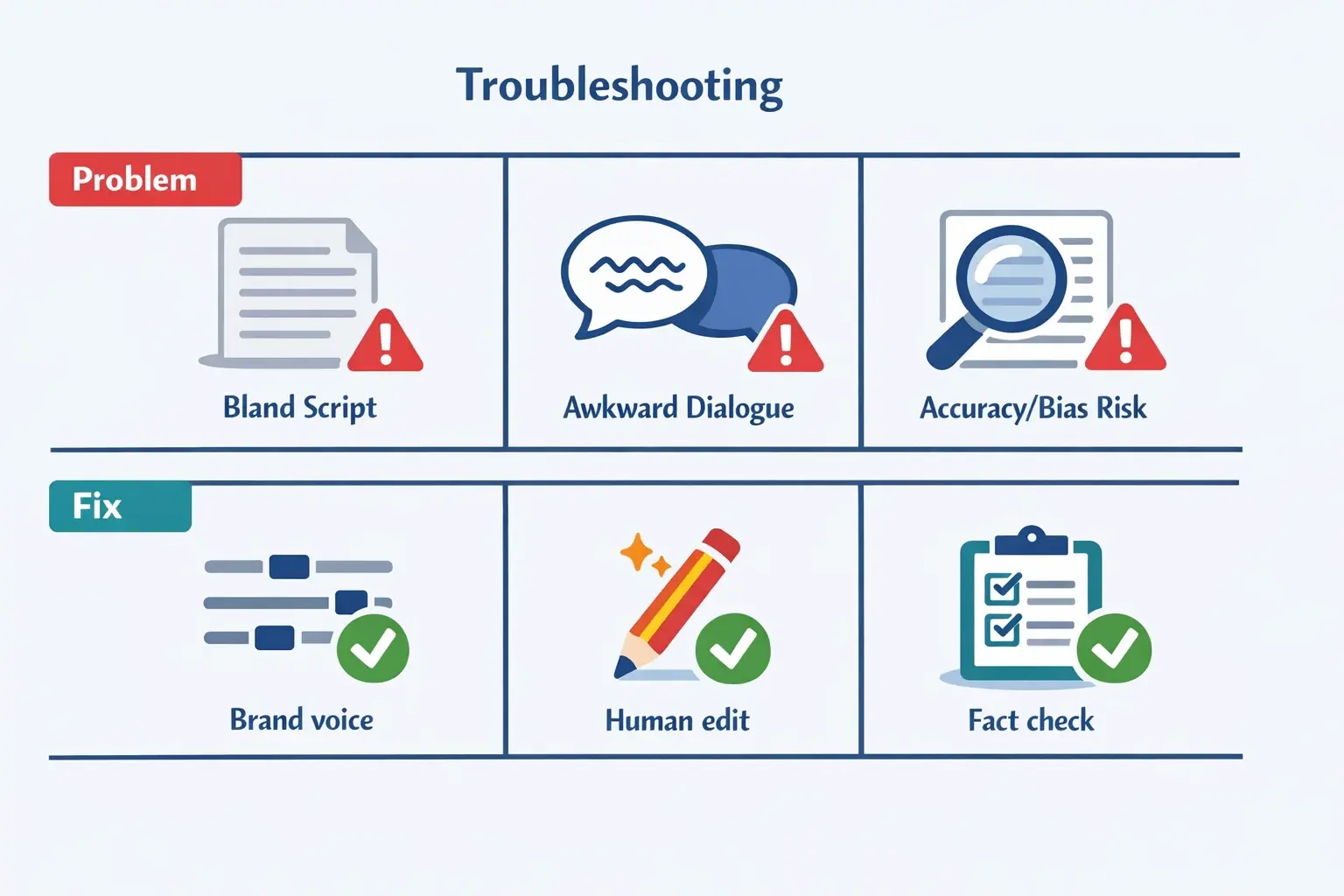
Even with great prompts, AI can sometimes veer into the “Uncanny Valley”—producing dialogue that sounds just a bit too robotic or visuals that don’t make logical sense.
How do you fix it? By auditing your outputs.
- The “Robotic Hook” Failure: The AI writes a hook like, “Are you tired of losing time on manual tasks?”
- The Fix: Edit for pattern disruption. Change it to, “You’re burning 14 hours a week doing things a $10 software could do for you.”
- The “Wall of Text” Failure: The AI suggests 30 seconds of non-stop talking.
- The Fix: Inject “B-roll breaks.” Add visual pauses where the product simply speaks for itself.
Action: Implementing & Scaling AI-Powered Video Campaigns
Scaling your content means integrating these new tools into your daily workflow. The goal isn’t just to make one good video; it’s to build a system that churns out high-quality video concepts repeatedly.
Staying on top of the latest ai workflows hacks products features 2026 will ensure your tech stack is always working for you, not against you. Connect your AI script generator to your project management tools so that the moment a storyboard is approved, it pings your video editing team.
As you launch these campaigns, the data will start rolling in. You might start asking complex questions—like, are there ways to compare the explainability of different ai-driven marketing analytics platforms before piloting? Ensuring you can clearly read the ROI of your AI-generated videos is what will ultimately secure your marketing budget for the next quarter.
FAQ: Beginner Questions on AI Video Scripting
What is an AI video script generator?It’s a software tool powered by artificial intelligence that helps marketers write, structure, and format dialogue and visual cues for video content based on text prompts.
Will AI replace human scriptwriters?No. AI replaces the “blank page syndrome.” It is exceptional at drafting structures, brainstorming angles, and formatting text. However, human marketers are still required to inject brand voice, empathy, factual accuracy, and strategic context.
Can I use AI to create storyboards?Yes! While text-based AI won’t draw the pictures for you (unless you use a multimodal image generator), it is incredible at creating “shot lists.” You can prompt the AI to suggest camera angles, B-roll footage, and on-screen text to accompany the dialogue.
How do I make sure my AI script doesn’t sound generic?The secret is in the prompt and the edit. Feed the AI strict brand guidelines, ask it to adopt a specific persona, and never publish the first draft. Always do a “human pass” to tweak the pacing and vocabulary to fit your unique brand voice.
Is AI script generation free?Many foundational AI models (like ChatGPT or Claude) offer free tiers that are more than capable of drafting basic scripts. However, specialized marketing tools that offer built-in storyboarding, text-to-video integrations, and team collaboration features typically operate on a paid SaaS model.
Your Next Steps
AI isn’t a silver bullet, but when applied methodically from script to storyboard, it is the ultimate lever for marketing efficiency. You are no longer constrained by the time it takes to ideate; you are only limited by your strategic imagination.
Ready to dive deeper and build your ultimate marketing toolkit? At Swipe Directory, we continuously curate the highest-quality, unbiased resources to help you scale. Explore our categories to find the perfect AI tools, growth strategies, and execution guides tailored for your next big campaign.