
Picture this: It’s the end of the quarter. You’re sitting in a budget review meeting, and your CFO slides a spreadsheet across the table. They point to a rapidly growing line item labeled “AI Content Subscriptions” and ask a deceptively simple question: “What exactly are we getting for this?”
If your immediate instinct is to say, “Well, we’re saving a lot of time,” you’re not alone. But in 2026, simply citing “time saved” is no longer enough to justify continuous investment in your marketing stack.
Marketing teams today are caught in a frustrating paradox. We are seeing rising investments in artificial intelligence, yet when it comes time to report on performance, the actual financial returns remain elusive. It’s easy to see that an AI writing assistant drafts a blog post faster, but how do you trace that speed back to bottom-line revenue? How do you put a monetary value on an AI-optimized landing page?
If you’re struggling to connect your AI usage to hard metrics, you aren’t failing—you’re just relying on outdated measurement models. Let’s explore how to build a modern, multi-dimensional framework to measure the true Return on Investment (ROI) of your AI content tools.
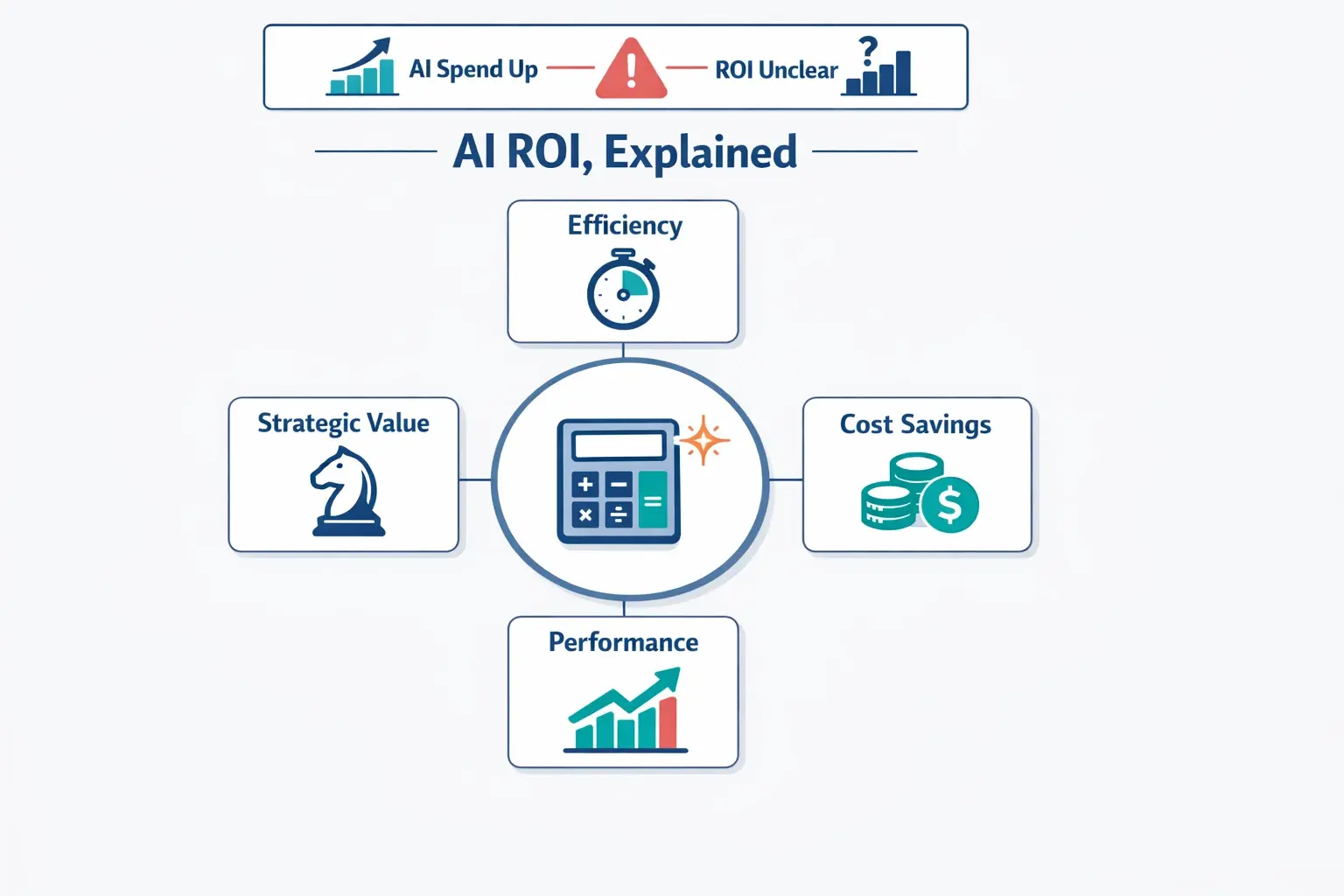
The AI ROI Paradox: Why Traditional Metrics Fall Short
Historically, ROI was simple: you spent $100 on an ad, and it generated $300 in sales. AI content tools don’t fit neatly into this box.
When marketing teams try to force AI into traditional ROI calculations, they usually hit a wall. Here’s why: traditional metrics often measure isolated touchpoints, whereas AI content tools impact the entire creative ecosystem. If you speed up your content production but the quality drops—a phenomenon some call “faster failure”—you haven’t actually improved your efficiency. You’ve just become more efficient at producing things that don’t convert.
To truly capture the value of these tools, we have to look beyond simple cost-cutting. Industry research from organizations like Thomson Reuters highlights that successful AI adoption requires measuring both tangible and intangible benefits across four layers:
- Efficiency & Cost (Tangible): Reductions in agency spending, faster drafting, and lowered production costs.
- Revenue & Growth (Tangible): Increases in organic traffic, higher conversion rates on AI-optimized copy, and accelerated lead generation.
- Strategic & Operational (Intangible): Risk mitigation, improved brand consistency, and the ability to scale campaigns rapidly.
- Customer & Team Experience (Intangible): Better client experiences through personalized content, improved decision quality, and higher team retention because your marketers are doing less grunt work.
To turn these high-level concepts into hard data, you need a structured approach.
A Step-by-Step Framework for Measuring AI Content ROI
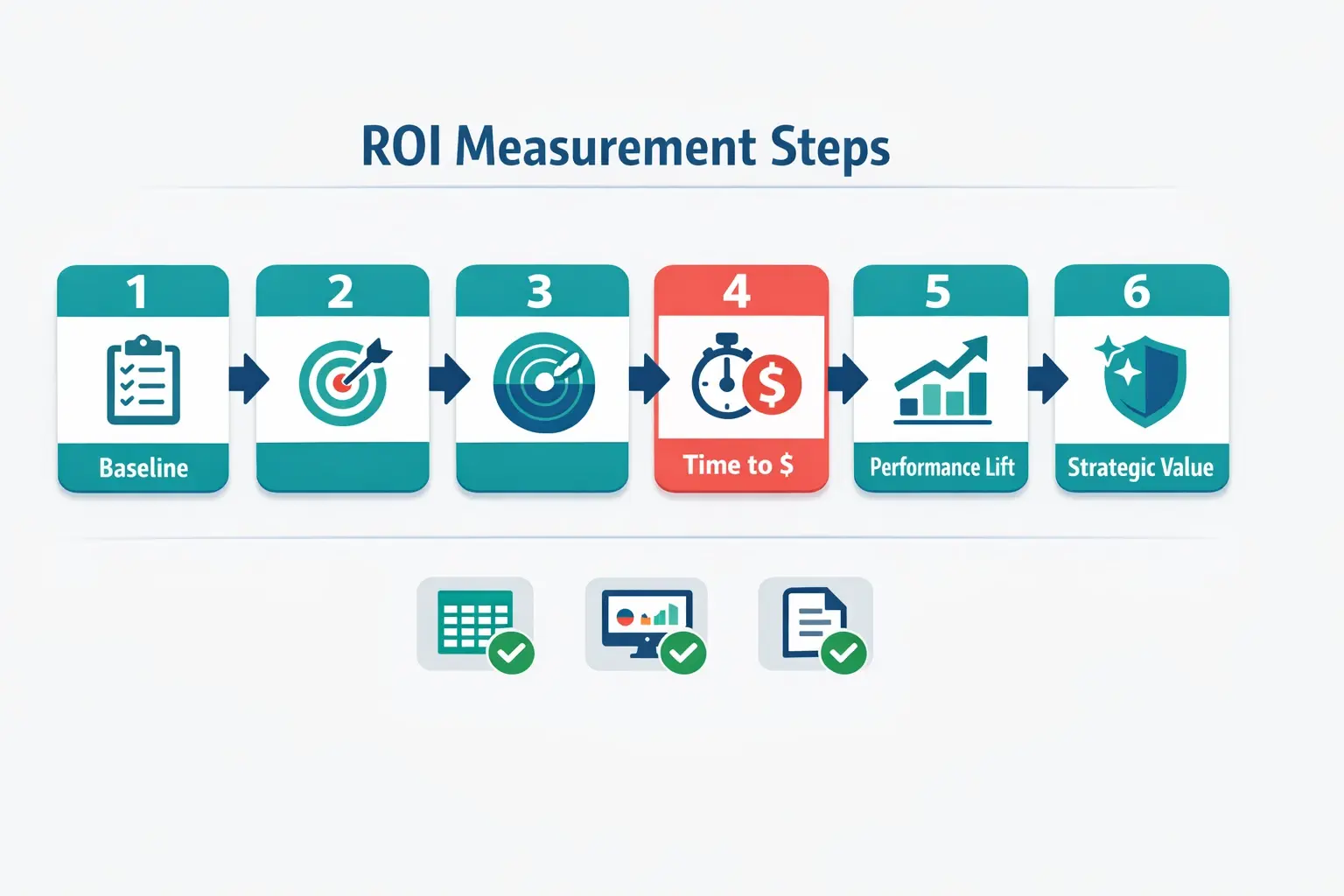
If you’re just stepping into the world of marketing ai, adopting a proven measurement framework is your first critical step. Here is a progressive methodology that bridges the gap between everyday AI usage and executive-level financial reporting.
Phase 1: Establish Your Baselines
You cannot measure what you haven’t benchmarked. Before integrating an AI tool, document your current state. How many hours does it take your team to research, draft, and edit a standard 1,500-word article? What is your average freelance or agency spend per month? What are your baseline conversion rates for email campaigns?
Phase 2: Define AI Content Tool Goals & KPIs
Move away from vague goals like “write faster.” Create SMART (Specific, Measurable, Achievable, Relevant, Time-bound) goals. For example: “Reduce the time spent on initial blog drafts by 40% over the next quarter without dropping average time-on-page metrics.”
Phase 3: Track AI Usage & Outputs
You need to correlate usage with output. Tracking adoption is vital. Are your team members actually using the tool? Track feature utilization, the number of prompts run, and the volume of content assets generated purely or partially through AI.
Phase 4: Quantify Productivity Gains & Cost Savings
This is where you monetize time. If an AI tool saves a marketer 10 hours a week, and that marketer’s hourly rate (including overhead) is $50, you have effectively “saved” or reallocated $500 a week. Additionally, factor in hard cost savings—did using an AI SEO optimizer allow you to cancel a separate, more expensive legacy subscription?
Phase 5: Measure Content Performance Improvements
Efficiency doesn’t matter if performance plummets. Measure the output of your AI-assisted content against your baselines. Look at organic traffic growth, keyword rankings, engagement rates (Click-Through Rates, time on page), and ultimately, conversion rates from AI-generated or optimized content.
Phase 6: Assess Strategic & Intangible Benefits
Don’t ignore the softer metrics. Are you able to launch campaigns a week faster, allowing you to beat competitors to market? Has the quality of your team’s strategic thinking improved because they aren’t bogged down in repetitive tasks? These elements, while harder to put on a balance sheet, are critical to your overall ROI narrative.
The ROI Formula for Marketing Content Teams
Once you have your data, you can apply a standard formula adapted specifically for your content operations:
ROI = [(Net Benefits – Total Costs) ÷ Total Costs] × 100
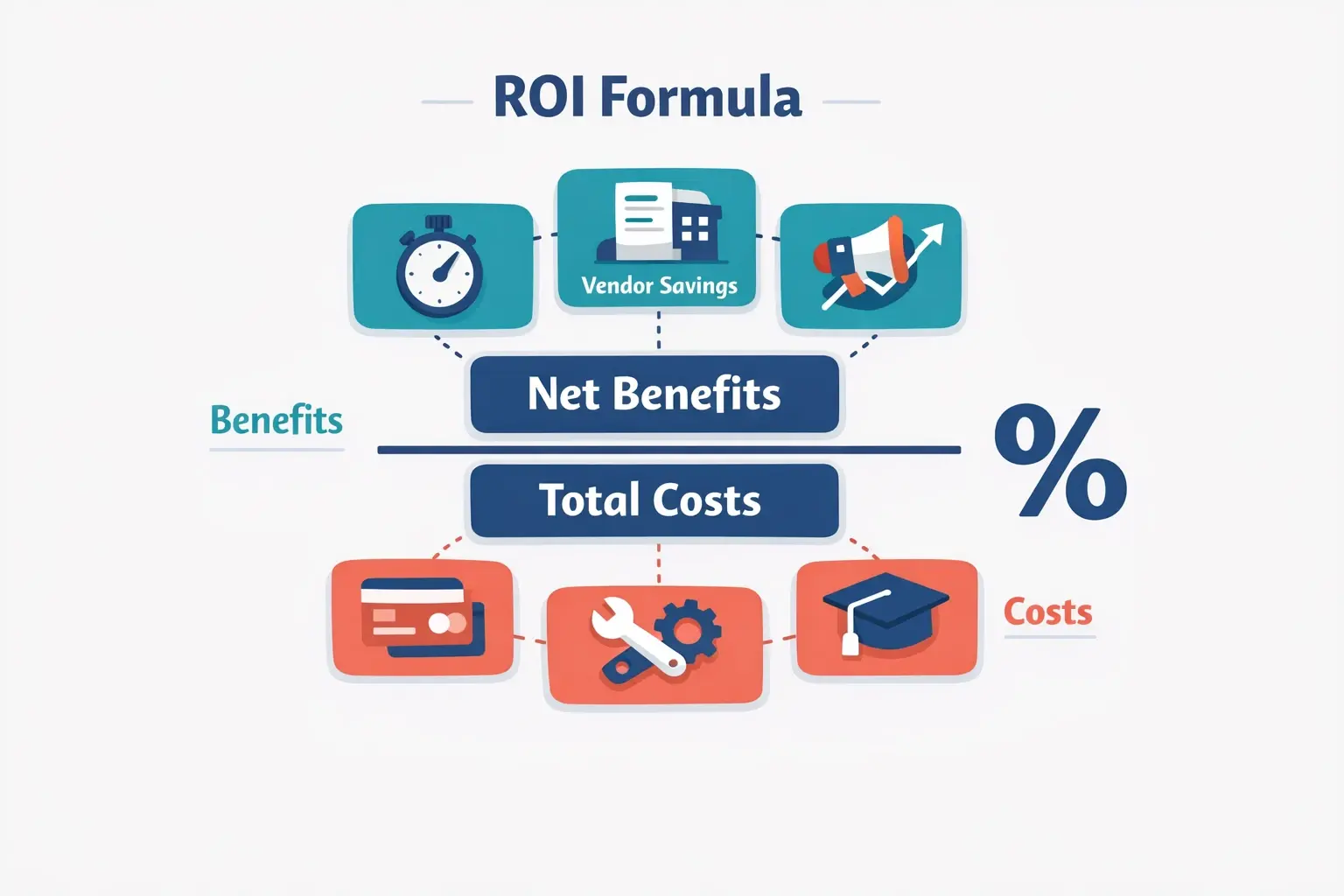
Let’s look at a hypothetical snapshot for a small marketing team using a new AI writing and SEO optimization platform over a three-month period:
Calculating Total Costs:
- AI Software Subscription: $1,500
- Employee Training & Implementation Time: $1,000
- Total Cost: $2,500
Calculating Net Benefits:
- Agency/Freelancer Cost Reduction: $3,000 (brought draft writing in-house)
- Time Reallocated (50 hours saved at $50/hr): $2,500
- Value of Increased Conversions (attributable to AI A/B testing variations): $2,000
- Total Benefits: $7,500
The Math: [($7,500 – $2,500) ÷ $2,500] × 100 = 200% ROI
In this scenario, for every dollar spent on the AI tool and training, the marketing team generated two dollars in value through savings and new revenue.
Avoiding Pitfalls and Advanced Measurement Techniques
While the math looks great on paper, many marketing leaders stumble during implementation. As your team relies more heavily on these platforms, you must navigate advanced measurement challenges.
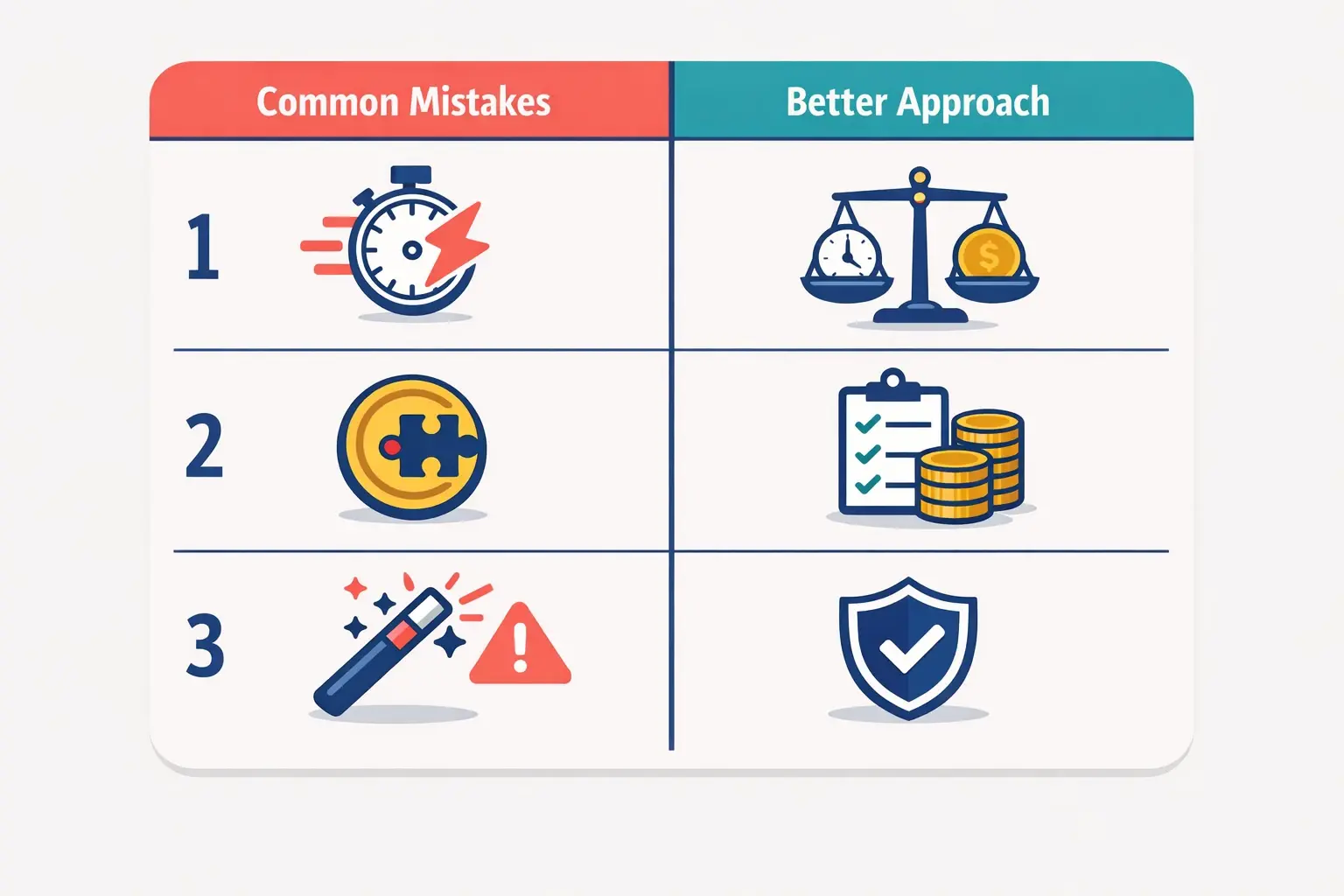
The “Hidden Costs” Trap
A common misconception is treating software subscription fees as the only cost. The total cost of ownership (TCO) must include the hours spent training your team, the time invested in prompt engineering for marketing to get the outputs right, and the ongoing human-in-the-loop editing required to ensure brand safety. If you ignore implementation costs, your ROI will be artificially inflated.
Multi-Touch Attribution for AI
Content rarely converts a customer on the first touch. If an AI tool helped outline an eBook, which was then edited by a human, and a prospect downloaded it before buying a product three weeks later—how much credit does the AI get?
Advanced marketing teams are moving toward multi-touch attribution models that credit AI-assisted assets proportionally. They aren’t trying to prove the AI made the sale alone; they are proving the AI accelerated the funnel velocity.
Risk-Adjusted ROI and Quality Control
Speed without accuracy is a liability. AI hallucinations, biased outputs, or off-brand tone can severely damage your brand equity. When measuring ROI, factor in a “risk adjustment.” This means intentionally budgeting time for human oversight. The most successful teams don’t use AI to replace human creativity; they use it to amplify human potential. A true ROI calculation must account for the human time required to edit, fact-check, and polish AI outputs.
Comprehensive FAQ for Measuring AI Tool ROI
What are the standard industry benchmarks for AI content ROI?While every industry varies, recent 2026 data indicates that optimized marketing teams often see a 60% to 70% reduction in external content production expenses and a 3x to 5x boost in first-draft creation speed. However, benchmark your performance against your own historical data first.
How do we account for the opportunity cost of not using AI?Opportunity cost is the revenue you forfeit by moving slower than your competitors. While hard to measure precisely, you can estimate this by looking at your current content backlog. If a lack of resources prevents you from launching three major campaigns a year, calculate the projected revenue of those campaigns—that is the cost of not modernizing your workflow.
How can a small team with no data analysts measure this effectively?Keep it incredibly simple. Focus on two metrics: Money saved on external contractors (hard dollars) and hours saved per week multiplied by average hourly salary (soft dollars). Compare that combined number to your monthly software fee. If the savings outpace the fee, you have a positive ROI baseline to build upon.
Does ROI look different for content strategy versus content creation?Yes. Content creation tools (like AI writers) offer immediate, easily measurable time savings. Strategy tools (like predictive analytics and SEO clustering) offer long-term performance gains. This is why comparing explainability of ai marketing analytics platforms before piloting is so vital—you need to understand why the AI is suggesting a certain strategy so you can accurately measure its eventual impact on your organic traffic six months down the line.
Next Steps for Deeper Exploration
Measuring the ROI of AI content tools doesn’t require a degree in data science, but it does require a shift in perspective. By moving past the generic “time saved” argument and implementing a structured framework that captures efficiency, performance, and strategic growth, you can transform AI from a questionable expense into a quantifiable competitive advantage.
The key is to start small. Choose one high-impact AI tool currently in your workflow, establish your baselines today, and run a 30-day measurement sprint.
As you refine your approach, the data you gather won’t just justify your budget to the CFO—it will illuminate entirely new ways for your marketing team to scale, innovate, and connect with your audience.