
We’ve all been there. You stare at the blinking cursor, type “Write a LinkedIn post about our new marketing software,” hit enter, and watch the AI confidently generate the most robotic, jargon-filled, soulless block of text you’ve ever read. It likely starts with “🚀 Exciting news!” and ends with a dozen irrelevant hashtags.
If you are treating modern AI like a simple search engine, you are going to get generic results. In 2026, the competitive advantage doesn’t belong to the marketer who simply uses AI; it belongs to the marketer who knows how to communicate with it effectively.
This communication skill is called prompt engineering, and when applied specifically to marketing copy, it is the bridge between a mediocre first draft and a highly converting, on-brand masterpiece.
Whether you’re a startup founder wearing multiple hats or a seasoned digital marketing professional, understanding the architecture of a great prompt will save you hours of frustration. Let’s peel back the curtain on how to transform your AI outputs from generic fluff into precise, high-quality content.
The Core Problem: Why Your AI Copy Sounds “Like AI”
The fundamental mistake most marketers make is assuming the AI shares their context. When you ask an AI to write a promotional email, it draws upon the statistical average of millions of emails in its training data. By definition, an average prompt yields an average result.
To overcome this, we must build a framework for specificity. Think of prompt engineering less like coding, and more like onboarding a highly capable but completely uninitiated freelance junior copywriter. You wouldn’t hand a freelancer a one-sentence brief and expect a masterpiece. The same applies to Large Language Models (LLMs).
The 4 Pillars of a Perfect Marketing Prompt
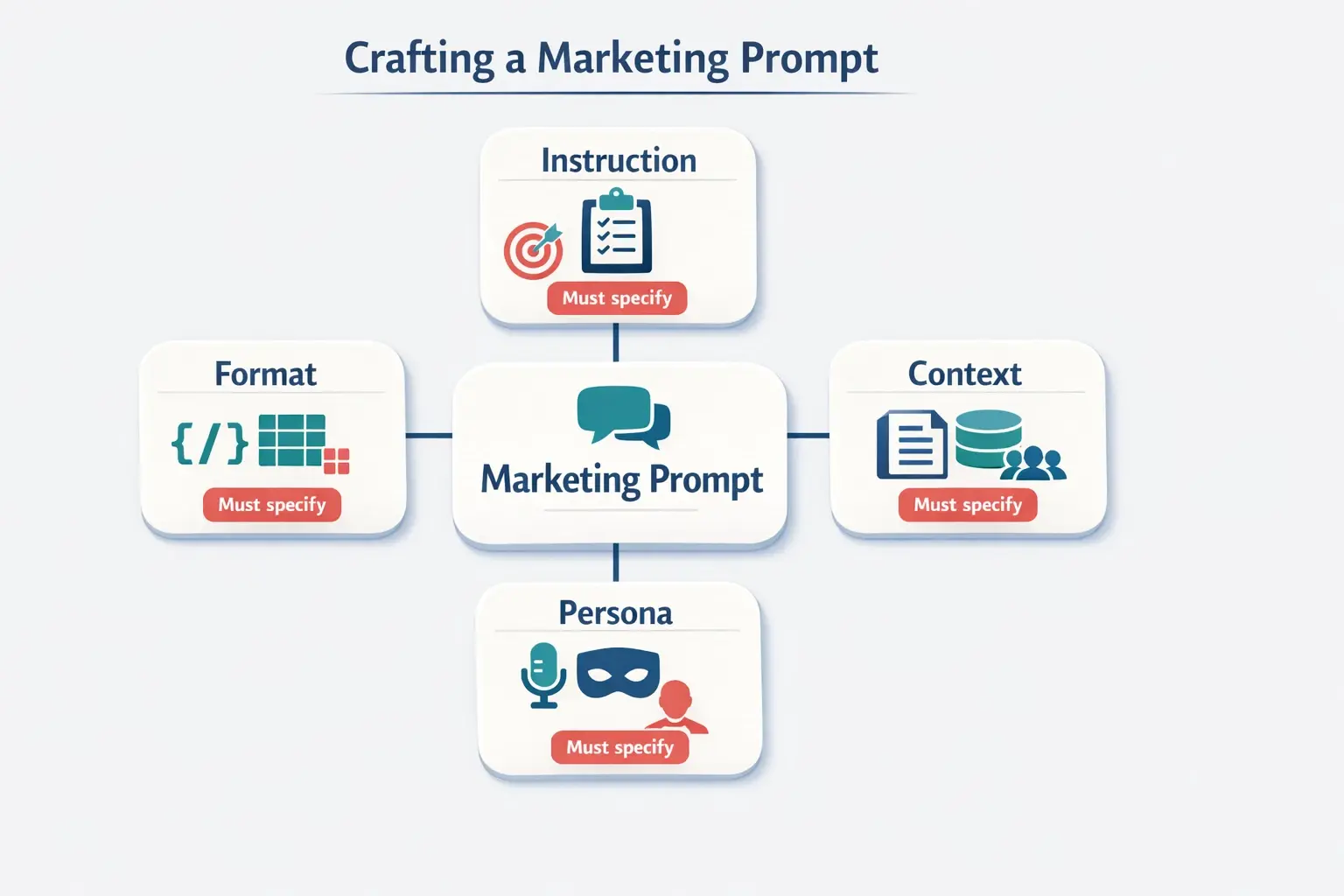
To consistently generate copy that sounds like your brand, every prompt should contain four core elements. We call this the “4 Pillars of Marketing Prompt Excellence”:
- The Instruction (The What): What exactly is the task? Be verb-driven. Instead of “A blog post about SEO,” use “Write a 500-word educational introduction for a blog post explaining the evolution of SEO.”
- Contextual Data (The Why & Who): Provide the background. Who is the target audience? What are their pain points? What is the core value proposition of your product?
- The Persona (The How): This is your secret weapon for tone. Ask the AI to adopt a specific identity. “Act as a seasoned, cynical B2B SaaS marketer who hates fluff and speaks directly to ROI.”
- The Desired Format (The Output): Tell the AI exactly how you want the information presented. Do you want markdown formatting? Bullet points? A table? A specific character limit for Twitter?
From Basic to Brilliant: Iteration and Troubleshooting
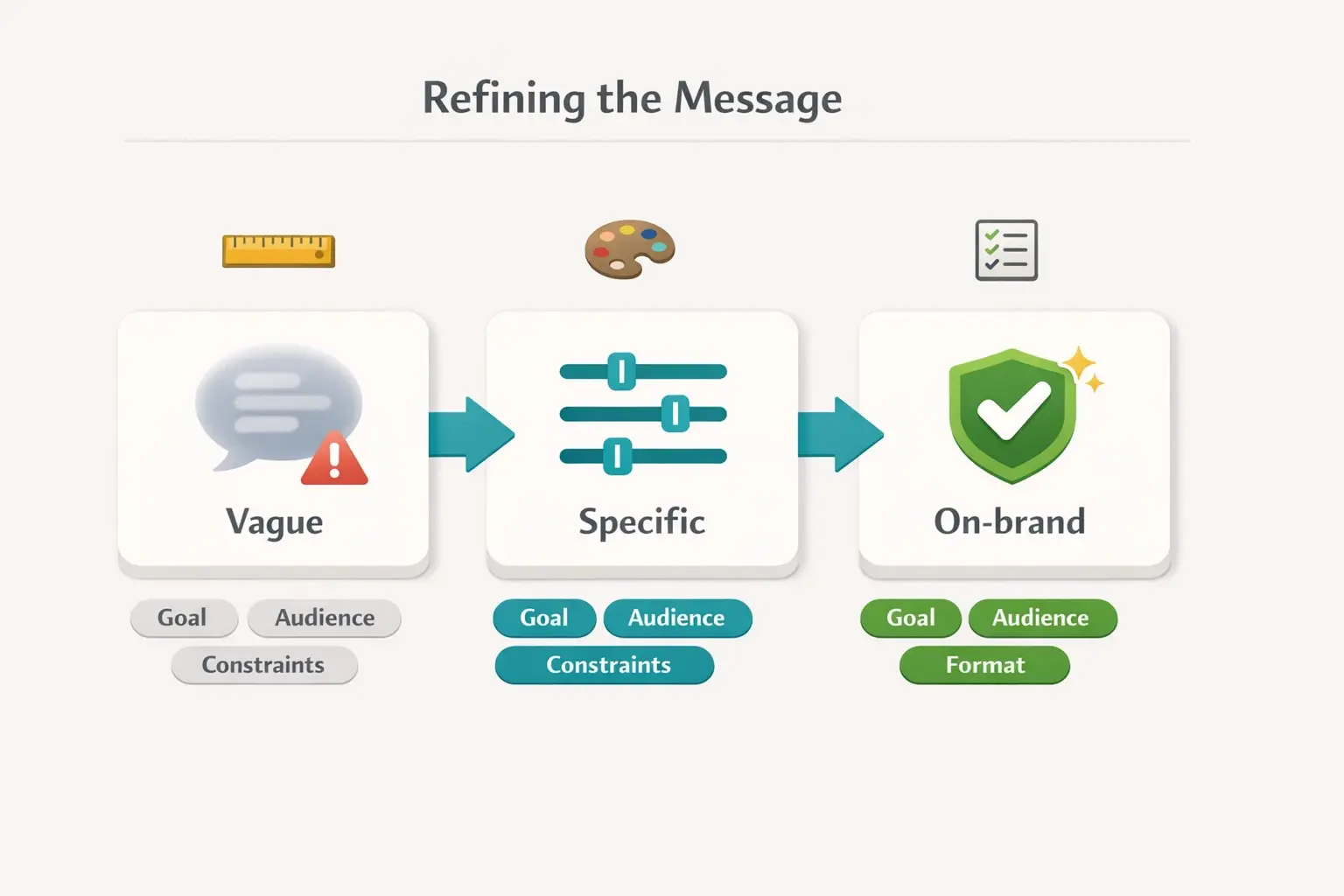
Even with the four pillars in place, your first output might not be perfect. The true art of prompt engineering for marketing lies in the iteration process.
If your AI output feels generic, you likely have a vagueness problem.
- The Fix: Introduce negative constraints. Tell the AI what not to do. Add phrases like: “Do not use words like ‘innovative,’ ‘synergy,’ or ‘revolutionary.’ Avoid opening with a question.”
If the AI is getting your product features wrong, you have a hallucination problem.
- The Fix: Ground the model by providing the exact text it should reference. Paste your landing page copy into the prompt and say, “Using ONLY the features listed in the text below, write an ad headline.”
AI is deeply cooperative. If an output is wrong, don’t start a brand new chat. Instead, reply to the AI with specific feedback: “This tone is too enthusiastic. Tone it down by 40%, make the sentences shorter, and focus on the financial cost of not using our product.”
Advanced Prompt Engineering Techniques for Marketers
Once you’ve mastered the foundational pillars, you can begin exploring advanced techniques that push AI models to operate as strategic partners rather than just rapid typists.
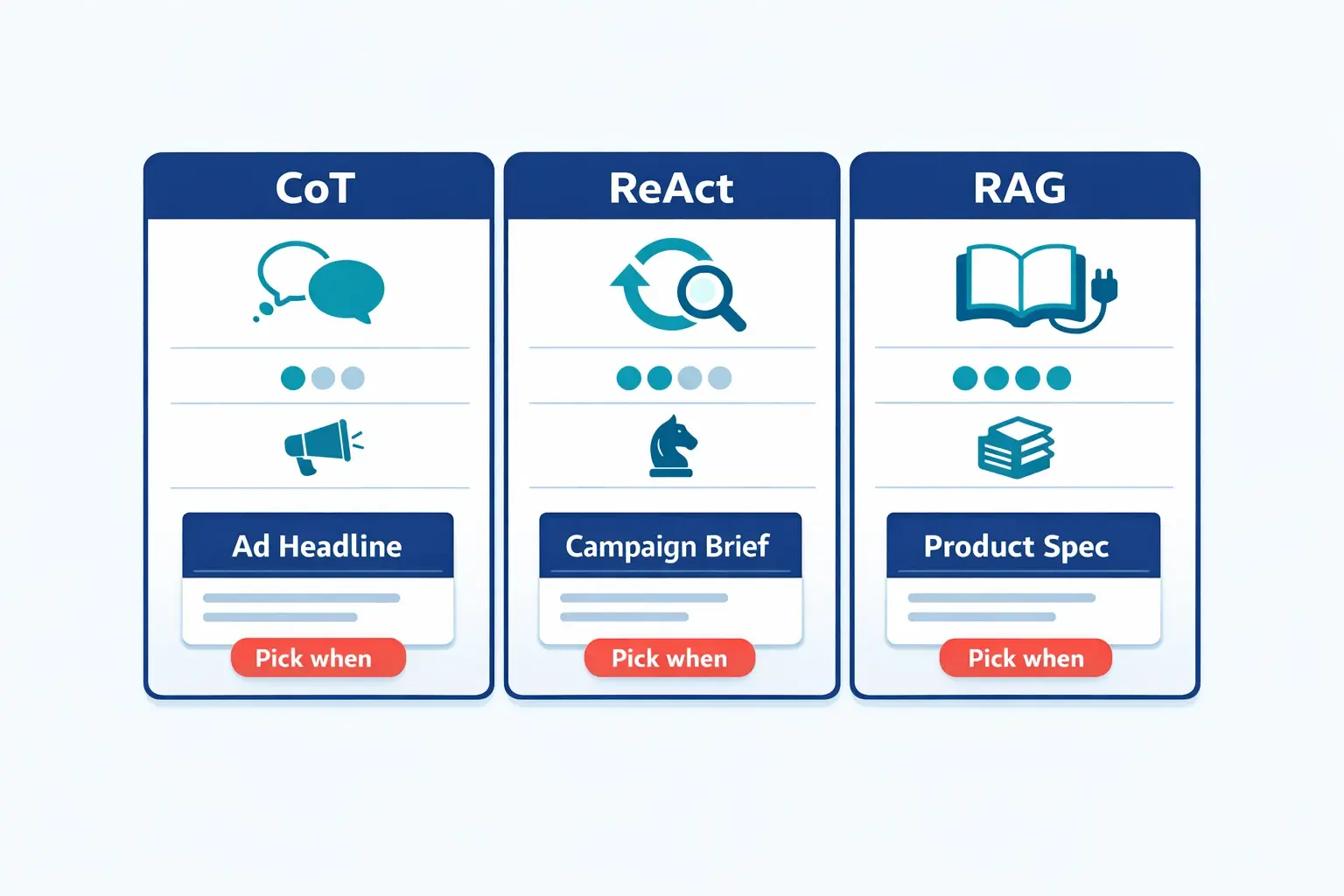
Chain-of-Thought (CoT) for Strategic Campaigns
Chain-of-Thought prompting involves asking the AI to “show its work” before giving you the final output. This is incredibly powerful for complex marketing tasks.
Instead of asking the AI to write a cold email, ask it to:
- First, analyze the target audience’s core daily frustrations.
- Second, brainstorm three different emotional angles to approach those frustrations.
- Third, select the strongest angle and write a 4-sentence cold email based on it.
By forcing the AI to reason through the strategy before writing the copy, the final output becomes drastically more logical and persuasive.
Few-Shot Prompting for Brand Voice
“Zero-shot” prompting is asking an AI to do something without examples. “Few-shot” prompting is providing the AI with 2 to 5 examples of your best-performing copy before asking it to write a new one.
If you want the AI to write an engaging Facebook ad, paste three of your historical top-performing ads into the prompt and say: “Here are three of our best Facebook ads. Analyze their sentence structure, tone, and call-to-action style. Then, write a new ad for [New Product] following the exact same stylistic rules.”
RAG (Retrieval-Augmented Generation) for Marketers
While RAG sounds like a complex engineering term, for marketers, it simply means connecting an AI to your proprietary data. Instead of relying on the AI’s general training, a RAG system pulls directly from your company’s internal brand guidelines, historical blog posts, and product wikis to formulate its answers. This ensures your copy is 100% factually accurate to your specific business ecosystem.
Operationalizing AI: Workflows, Ethics, and Prompt Libraries
The most efficient marketing teams in 2026 don’t rely on individuals remembering how to write good prompts. They build systems.
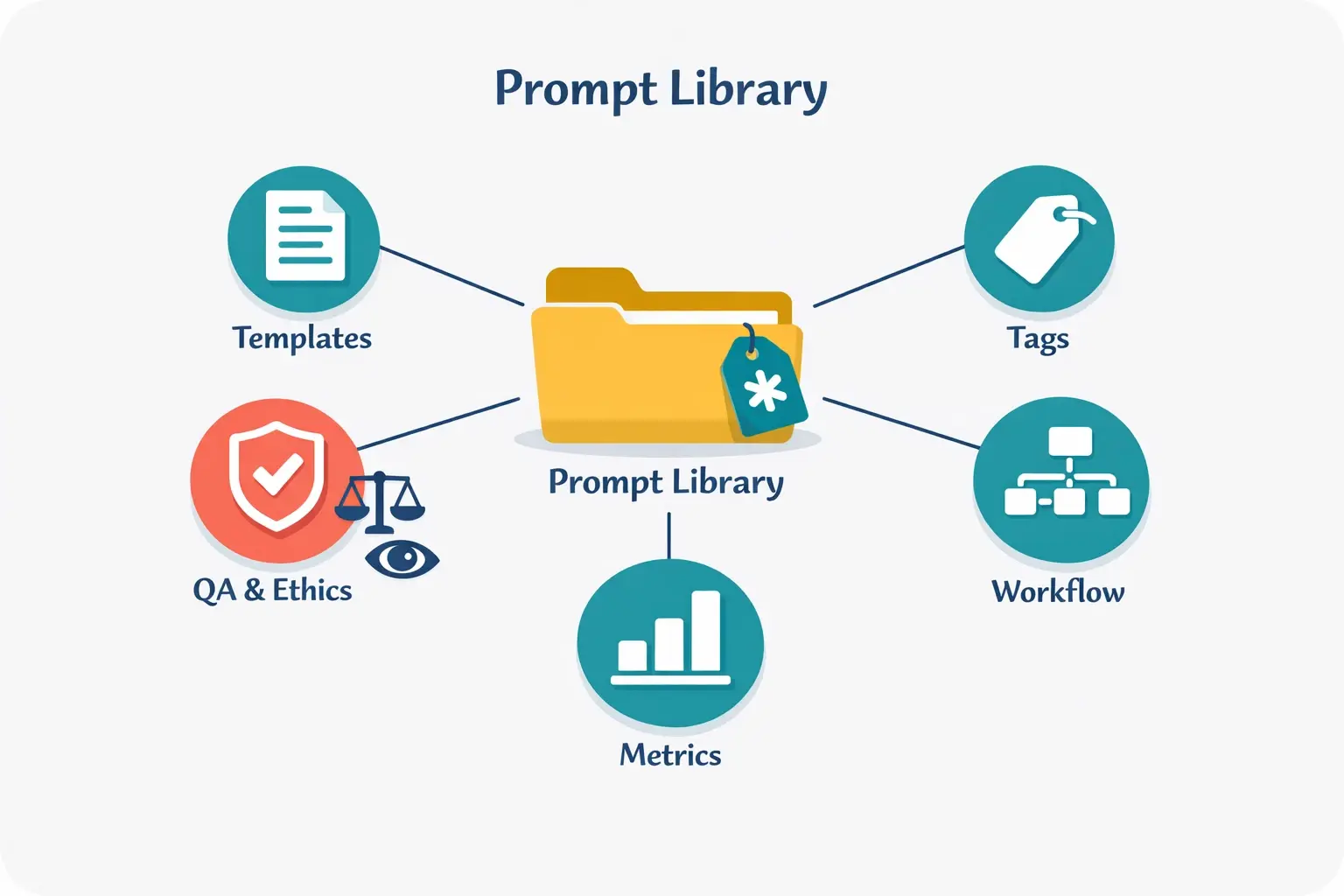
Creating a Prompt Library is an essential next step. Whenever you or a team member strikes gold with a specific prompt structure, save it as a template with fill-in-the-blank brackets (e.g., [Insert Target Audience], [Insert Product Feature]). Tag these prompts by channel (Email, SEO, Paid Ads) and goal (Conversion, Awareness).
Integrating these libraries into your daily ai workflow automation 2026 ensures that your entire marketing team maintains a consistent, high-quality brand voice, regardless of who is operating the AI.
However, with great efficiency comes responsibility. Marketers must remain vigilant about ethical AI use. Always human-review AI-generated copy for subtle biases, ensure factual claims are verifiable, and be mindful of copyright boundaries when asking AI to mimic specific living creators. AI is a co-pilot, not an autopilot.
Frequently Asked Questions (FAQ)
What is the difference between a copywriter and a prompt engineer?A traditional copywriter uses their own cognitive abilities to draft text from scratch. A prompt engineer for marketing uses strategic inputs to guide an AI to generate the text. The best modern marketers are a blend of both—using prompt engineering for heavy lifting and drafting, and their copywriting skills for human nuance, emotional resonance, and final polish.
How do I prevent AI from using cliché marketing jargon?Use strict negative constraints in your prompt. Explicitly state: “Do not use words like ‘unlock,’ ‘supercharge,’ ‘revolutionize,’ or ‘game-changer.’ Use simple, conversational English at an 8th-grade reading level.”
Are advanced techniques like CoT or RAG necessary for everyday marketing copy?Not always. For a quick social media caption, a well-structured basic prompt using the 4 Pillars is usually enough. Advanced techniques are best reserved for high-stakes, complex tasks like drafting a quarter-long email nurture sequence, creating comprehensive SEO pillar pages, or ensuring deep technical accuracy.
How can I measure if my prompt engineering is actually working?The ultimate metric is the performance of the copy itself (click-through rates, conversions, time-on-page). However, operationally, you should measure the time saved in the drafting phase and the reduction in editing rounds required by human managers.
Next Steps in Your AI Marketing Journey
Mastering prompt engineering doesn’t happen overnight. It requires a willingness to experiment, fail, and refine. Start by taking one piece of generic AI copy you’ve generated recently. Apply the 4 Pillars framework—adding strict instructions, deep context, a specific persona, and formatting rules—and watch how dramatically the output improves.
As you build confidence, begin experimenting with Few-Shot examples to lock in your brand voice. The goal isn’t to replace your creativity with AI; the goal is to use AI to clear away the blank page, giving you the time and mental energy to focus on the high-level marketing strategies that actually grow your business. Keep testing, keep refining, and start building your ultimate marketing prompt library today.